No-Limit Texas Hold'em: Official Rulebook
''
- Document
- 'Official Rulebook'
- Game
- No-Limit Texas Hold'em
- Standards
- TDA 2024 · Robert's Rules
Contents
About this rulebook
What Version 1 covers
- This book is the complete rules of No-Limit Texas Hold'em, across cash games, tournaments (Multi-Table Tournaments), and Sit & Go.
- A separate Pot-Limit Omaha rulebook follows in Phase B. Other variants (Omaha Hi-Lo, Stud, Razz, Short Deck) are referenced in the glossary but not yet given full chapters.
- The glossary is split into General, Hold'em, and Tournament terms, each in alphabetical order.
Rules, not strategy
This book teaches how the game is played and what the words mean: the mechanics every player must know. It does not teach how to play well. That is the job of the PokerWize Campaign. Wherever a term is really about strategy, the glossary flags it with "→ Strategy taught in the Campaign" rather than trying to teach it here.
Which rules we follow
Poker conventions vary between rooms, so this book states a single clear standard and notes where houses differ:
- Tournament procedure follows the Poker Tournament Directors Association (TDA) 2024 rules, the most widely used tournament standard.
- Cash-game conventions follow Robert's Rules of Poker (Bob Ciaffone) and common U.S. cardroom practice.
- Where a rule is not universal (straddles, chopping blinds, run-it-twice), the book says so and treats it as a house option.
Part I: The Basics
What poker is
Poker is a betting game played with a standard 52-card deck. Over a series of betting rounds, players wager chips into a shared pool called the pot. A hand ends one of two ways: everyone but one player folds (gives up), and that last player wins the pot without showing any cards; or two or more players reach the showdown, turn their cards face up, and the best five-card poker hand wins.
In Texas Hold'em specifically, each player is dealt two private cards (hole cards) and shares five face-up community cards dealt in the middle of the table. You make your best five-card hand from any combination of your two hole cards and the five community cards. Anyone in a hand can use the community cards, but only you can use your hole cards. Keep them to yourself. You can use both hole cards, one, or even none of them.
Chips and money. Players bet with chips. In a cash game a chip is worth its face value in money; in a tournament chips are only used to keep score, and prizes are paid by finishing position.
The goal. Win chips. You do that by winning pots: either by having the best hand at showdown (after all betting rounds have completed), or by betting in a way that makes everyone else fold.
Hand rankings
Every poker hand is exactly five cards. Hands are ranked from strongest to weakest as shown below. A higher-ranked hand always beats a lower-ranked one, regardless of suits.
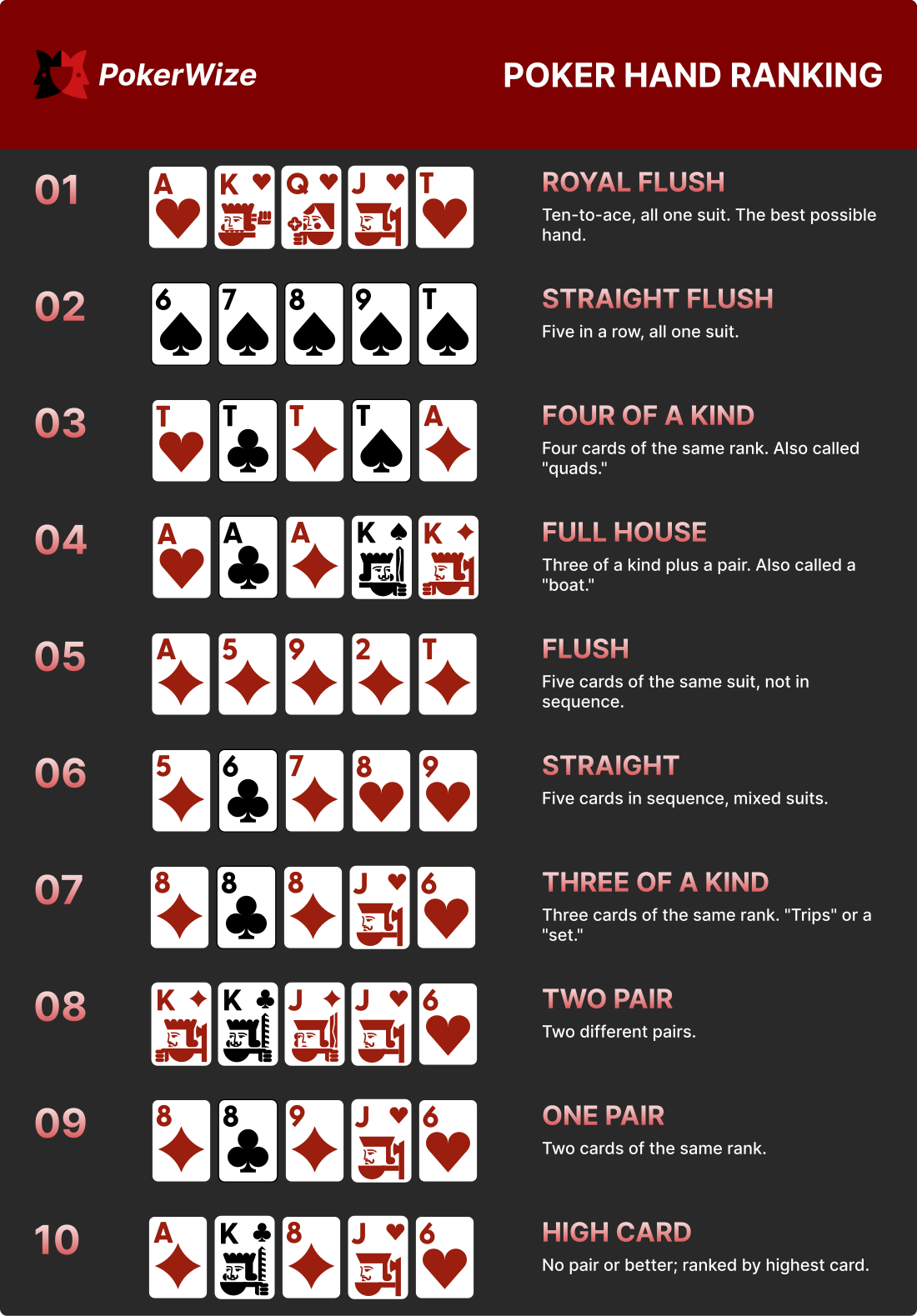
Ties and kickers
When two players hold the same class of hand, the higher cards decide it. With one pair, the pair is compared first; if the pairs are equal, the next-highest unpaired cards (the kickers) are compared one by one. If all five cards are equal in rank, the pot is split.
Suits never break a tie for the pot. In Hold'em no suit outranks another. Two identical-ranked hands split the pot: a spade flush does not beat an equal heart flush. Suit order is only used for side matters such as awarding an odd chip or drawing for the button (see Split Pots & Side Pots).
Special note: the wheel and the ace
The ace can be high or low in a straight. A-K-Q-J-10 is the highest straight; A-2-3-4-5 (the "wheel") is the lowest. The ace cannot "wrap around": Q-K-A-2-3 is not a straight.
Playing the board
If the five community cards make a better hand than anything you can form with your hole cards, you can "play the board." The best you can do that way is tie everyone still in the hand, so the pot is split among them.
The table & positions
Hold'em is a button game. A round disc called the dealer button marks the nominal dealer's seat. The button is the best position because that player acts last on every betting round after the flop. After each hand the button moves one seat clockwise, so the advantage rotates fairly around the table.
The blinds
Two forced bets seed the pot before any cards are dealt. The small blind (SB) is posted by the player immediately clockwise (left) of the button; the big blind (BB) is posted by the next player along, and is normally twice the small blind. Blinds count as that player's opening bet for the first round.
Stacks are measured in big blinds. "100bb deep" means each player has 100 times the big blind in front of them, the standard depth PokerWize trains.
Positions by table size
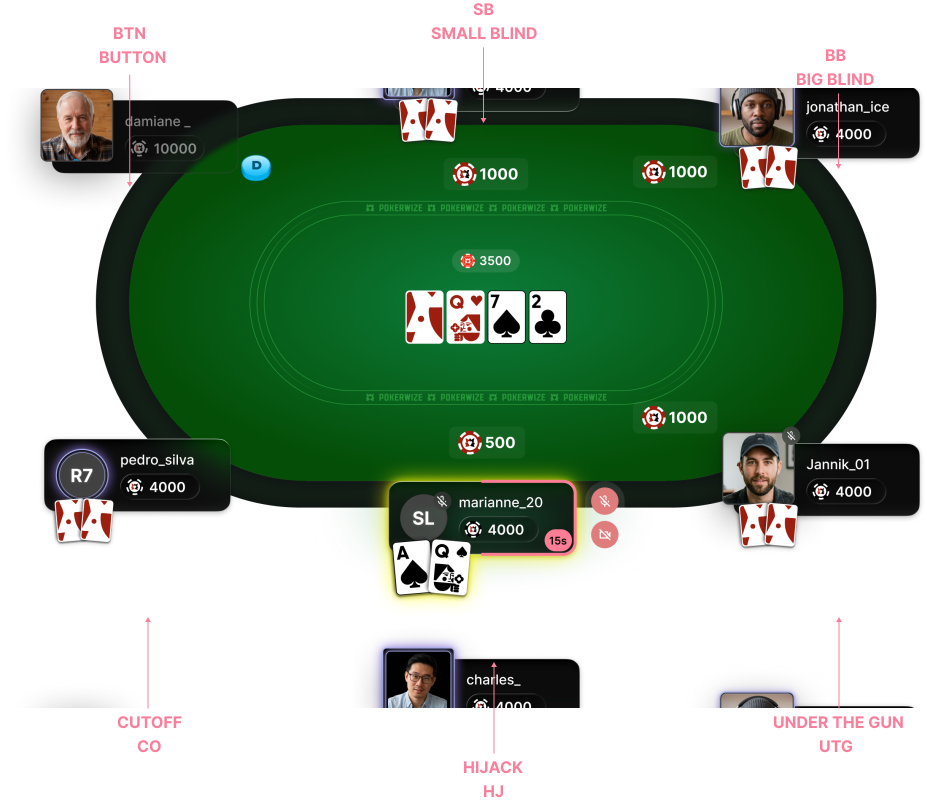
The names in play change with the number of seats, but two things are always true: the button acts last after the flop (the best seat), and the small and big blinds are the two seats to its left. PokerWize currently trains 6-max; the other formats are shown here so the vocabulary carries over.
Heads-Up (2 players)
- Button / Small Blind (BTN/SB): heads-up, the button posts the small blind. This player acts first before the flop but last on every later round.
- Big Blind (BB): posts the big blind; acts last before the flop and first afterwards.
6-max (6 players), trained now. In order of who acts first before the flop:
- Under the Gun (UTG): first to act, immediately left of the big blind.
- Hijack (HJ): the next seat along (also called Middle Position).
- Cutoff (CO): directly right of the button.
- Button (BTN): the dealer position; acts last after the flop.
- Small Blind (SB): posts the small forced bet.
- Big Blind (BB): posts the big forced bet; acts last before the flop.
9-max / full ring (9 players). Full ring adds more early and middle seats. In preflop order:
- UTG, UTG+1, UTG+2: the three earliest seats, starting immediately left of the big blind.
- Lojack (LJ): the first of the later positions, just before the hijack.
- Hijack (HJ): two seats to the right of the button.
- Cutoff (CO): directly right of the button.
- Button (BTN): the dealer position; acts last after the flop.
- Small Blind (SB), Big Blind (BB): the two forced blinds, immediately left of the button.
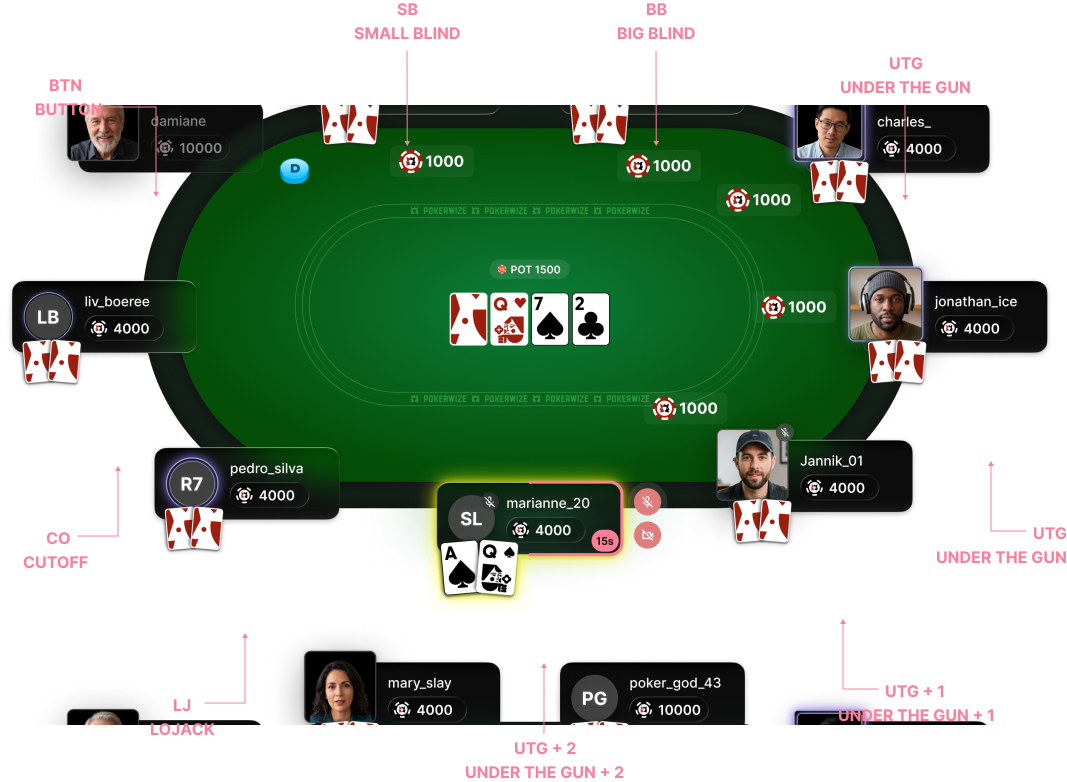
Preflop, action starts left of the big blind and ends with the big blind. On every later round it starts with the first active player left of the button and ends with the button, except heads-up, as noted above.
Part II: How a Hand Is Played
The betting rounds
A Hold'em hand has four betting rounds. Community cards are revealed between them. Before dealing the flop, turn, and river, the dealer "burns" the top card face down, a security habit that guards against a marked or glimpsed top card.
- Preflop: each player has their two hole cards. Betting starts left of the big blind.
- The Flop: three community cards are dealt together, then a betting round.
- The Turn: a fourth community card, then a betting round.
- The River: the fifth and final community card, then the last betting round.
If two or more players remain after river betting, the hand goes to showdown. If everyone folds at any point, the last player standing wins immediately.
Betting actions
On your turn you choose one action. Which actions are available depends on whether someone has already bet in this round.
If no bet is facing you
- Check: pass the action to the next player without betting, keeping your hand.
- Bet: put chips in and require others to match to continue.
If a bet is facing you
- Fold: give up your hand and any claim to the pot.
- Call: match the current bet to stay in.
- Raise: increase the bet. A re-raise is raising a raise (the third bet is a "3-bet," the fourth a "4-bet").
All-in. At any time you may bet every chip in front of you. You can never be forced to fold a hand you are all-in for; if others keep betting, a side pot is created for them.
Acting in turn
Play moves clockwise, one player at a time. Acting out of turn is not allowed: it gives away information and can unfairly influence players who haven't acted yet. A check-raise (checking, then raising after someone bets) is perfectly legal and is a normal part of the game.
Dead hand. A hand becomes dead (unable to win) if you fold, if it has the wrong number of cards, or if you let it touch the muck. Protect your cards (see Etiquette).
Betting rules (No-Limit)
"No-Limit" means there is no ceiling on a bet: at any point you may wager up to all the chips in front of you. The rules below keep betting orderly.
- Table stakes. You can only wager the chips you had on the table at the start of the hand. You cannot reach into your pocket for more mid-hand, and no one can win more from you than you have in front of you.
- Minimum bet. The smallest bet is the size of the big blind.
- Minimum raise. A raise must be at least as large as the previous bet or raise on that round. Example: if someone bets 10 and another raises to 25 (a raise of 15), the next raise must be at least another 15, i.e. to 40 or more.
- Short all-ins. If a player goes all-in for less than a full raise, it does not re-open the betting for players who have already acted; they may call the extra but cannot raise again on that round.
- Verbal declarations are binding. If it's your turn and you clearly say "fold," "check," "call," "bet," or "raise," you must do it.
- One oversized chip is a call. If you drop a single chip larger than the bet without saying "raise," it counts only as a call. To raise with it, say so first.
- No string bets. A raise must be made in one motion or announced first. You cannot put out a call, pause to read reactions, then reach back for more: that is a string bet and the extra won't stand.
The showdown
If two or more players are still in after the final bet, hands are revealed and the best five-card hand wins.
Who shows first
- If there was a bet or raise on the river, the last player to bet or raise shows first.
- If everyone checked the river, the first active player left of the button shows first, then clockwise.
A player may always choose to muck (not show) rather than reveal a losing hand, but a mucked hand cannot win the pot.
Reading hands and fair play
- Cards speak. The true value of a hand is what the cards actually make, not what a player calls it. If you misread your own hand, the cards still count.
- The dealer helps read. But you are responsible for tabling your cards face up to claim the pot.
- Right to see a called hand. At showdown a player who was called generally must show; other players may ask to see a called hand, a privilege that can be revoked if abused.
Split pots & side pots
Split pots and the odd chip
When two or more players tie for the best hand, the pot is split as evenly as possible. If it can't divide evenly, the leftover "odd chip" goes to the first tied player sitting clockwise from the button. No player receives more than one odd chip.
Side pots
A side pot forms whenever a player is all-in for less than the others want to bet. The all-in player can only win the portion they contributed to (the main pot); any further betting goes into a separate side pot that only the remaining players can win.
If several players are all-in for different amounts, multiple side pots are built the same way: smallest all-in first, then the next, and so on. Players in the side pot show their hands before anyone all-in for only the main pot.
Part III: Formats
Cash games
In a cash game (also called a ring game) chips equal money, blinds stay the same size, and you can join, leave, or cash out at (almost) any time. This is the format PokerWize trains first: 6-max, 100bb, No-Limit Hold'em.
- Buy-in. The chips you sit down with. PokerWize's training standard is 100 big blinds. Live rooms often set a No-Limit minimum around 40× the big blind and a maximum around 100–250×; exact limits are a house rule.
- Adding chips. You may top up your stack between hands, up to the table maximum. You cannot add chips in the middle of a hand (table stakes).
- Leaving and returning. A common rule: if you cash out and return to the same game within a short window (often an hour), you must buy back for at least what you left with, so you can't "rathole" winnings and return short.
- Straddle (house option). An optional extra blind, usually 2× the big blind, posted by the player left of the big blind before cards are dealt. The straddler acts last preflop and may raise. Not every game allows it.
- Chopping the blinds (house option). If everyone folds to the two blinds, they may agree to take their blinds back and not play the hand, where that is customary.
- Run it twice (house option). When players are all-in with cards to come, they may agree to deal the remaining board twice, each board worth half the pot, to reduce swings.
Tournaments (MTT)
In a multi-table tournament (MTT) everyone pays the same entry, receives the same starting stack of tournament chips, and plays until one person has all the chips. You cannot cash out chips: you win money by outlasting others into the paid places. Tournament procedure here follows the TDA 2024 rules.
Structure
- Blind levels. Blinds (and later antes) rise on a clock at fixed intervals, forcing action as stacks shrink relative to the blinds.
- Antes and the big blind ante. Later levels add antes. Most modern events use a big blind ante (BBA): the big blind posts one ante for the whole table. Under TDA 2024 this is calculated "big blind first" when a short stack can't cover both.
- Chip race / colour-up. When the smallest chips are no longer needed, they're removed by dealing a card per odd chip to award replacements. A player can never be eliminated by the race: a player with none left is given a chip first.
- In the money (ITM) & payouts. A set number of finishers are paid, more for higher places. The last player to bust before the money is the "bubble."
Procedure
- Dead button. As players bust, the button and blinds are kept fair using a dead button: the button may sit at an empty seat so the big blind is always posted by the correct player.
- All-in shows down. When a player is all-in and betting is complete, all remaining hands are turned face up.
- Table balancing & redraws. Players are moved to keep tables even; the field re-draws for new seats when it collapses to two tables and again to the final table.
- Heads-up. When two players remain, the small blind is on the button and acts first after the flop.
- Eliminated players leave. You must leave your seat immediately when knocked out.
- No devices or solvers. TDA 2024 (Rule 5) prohibits using strategy tools, apps, or advice from another person while in a hand. Penalties range from missed hands to disqualification.
Example blind structure (illustrative):
| Level | Small Blind | Big Blind | Ante (BB posts) | Duration |
|---|---|---|---|---|
| 1 | 100 | 100 | None | 20 min |
| 2 | 100 | 200 | None | 20 min |
| 3 | 200 | 300 | None | 20 min |
| 4 | 200 | 400 | 400 | 20 min |
| 5 | 300 | 600 | 600 | 20 min |
| 6 | 400 | 800 | 800 | 20 min |
| 7 | 500 | 1,000 | 1,000 | 20 min |
Sit & Go (SnG)
A Sit & Go is a tournament that starts as soon as its seats fill, rather than at a scheduled time. The most common form is a single table of players.
It follows the same tournament rules as an MTT, with a few practical differences:
- It begins on demand (when the table is full), not on a clock, so you can start one any time there are enough players.
- The field is fixed and small (often a single table), so it plays out and finishes quickly.
- Payouts are simpler: a single-table SnG typically pays the top finishers only (e.g., top 2–3), and some are winner-take-all.
Because the structure is compact, a Sit & Go is a good bridge between cash play and full tournaments.
Part IV: At the Table
Etiquette & conduct
Good etiquette keeps the game fair, fast, and pleasant. Most of these are enforceable rules, not just manners.
- Act in turn. Wait for your turn; acting early leaks information and can be penalised.
- Protect your hand. Keep your cards in view on the table and place a chip or marker on them so they aren't swept into the muck by accident.
- Don't splash the pot. Place bets in a neat stack in front of you, not thrown into the middle, so the amount can be verified.
- One player to a hand. You cannot get help with a live hand or discuss it with anyone while it's in play.
- Don't reveal a live hand. In a multiway pot, showing or discussing your cards before the betting is done unfairly affects the action.
- No slow-rolling. If you clearly hold the winning hand at showdown, reveal it promptly. Deliberately delaying to let an opponent think they've won is one of the worst breaches at the table.
- String bets. Announce a raise or move your chips in a single motion; reaching back for more is not allowed (see Betting Rules).
- Keep chips visible. Higher-denomination chips must be easy for opponents to see; you can't hide a big stack behind smaller chips.
- Tipping (live rooms). In brick-and-mortar cardrooms it's customary to tip the dealer after winning a pot. This doesn't apply to online play.
Fair play & integrity
Certain behaviours aren't just rude: they're cheating, and they carry the heaviest penalties, up to a permanent ban.
- Collusion. Two or more players secretly working together (signalling cards, whipsawing others with raises, or soft-playing a partner) is prohibited.
- Chip dumping. Deliberately losing chips to another player to transfer value is a form of cheating.
- Ghosting and prohibited tools. Getting real-time help from another person, or from a solver or strategy app, during a hand is banned (TDA 2024 Rule 5 in tournaments; the same principle applies to online integrity).
- Soft-play. Intentionally not betting or raising against a friend to protect them harms everyone else in the pot and is not allowed.
Online integrity on PokerWize
Online play adds one requirement live poker doesn't: the deal itself must be provably fair. PokerWize uses a cryptographically secure random number generator to shuffle, and plans independent RNG certification so players can trust that cards are dealt randomly and cannot be predicted or manipulated. (Certification details are tracked separately by the platform team.)
Appendix: Sources
For accuracy checks and any legal review. All rulebook copy is original explanation written for PokerWize; no text is reproduced from the sources below. They are cited as the authorities whose conventions we follow.
- Tournament procedure: Poker Tournament Directors Association (TDA), 2024 Rules, Version 1.0 (released Oct 2024; supersedes 2022; next review 2026). pokertda.com.
- Cash-game conventions: Robert's Rules of Poker (Bob Ciaffone), private-games edition, supplied reference. Copyright-protected; used as a convention reference only.
- Universal mechanics (hand rankings, deck, betting flow) are standard poker and require no single authority.