What is Texas Hold’em?
A poker game where every player gets two private cards and shares five face-up cards in the middle. There are four rounds of betting, and the pot goes to the best five-card hand at the showdown, or to the last player left if everyone else folds.
Episode 1 of Hold’em 101, our series for new players, written out for people who’d rather read than watch. First the rules, then one full hand from the first card to the winner.
The pot, and the two ways to win it
The pot is the pile of chips in the middle of the table, and whoever wins the hand takes it. There are only two ways to win it. Either everyone else gives up, which in poker is called folding, or you show your cards at the end and have the best hand. Everything else is just how you get there.
A quick question: if everyone else folds, do you have to show your cards? No. You take the pot, and nobody ever finds out what you had.
Your two cards and the five in the middle
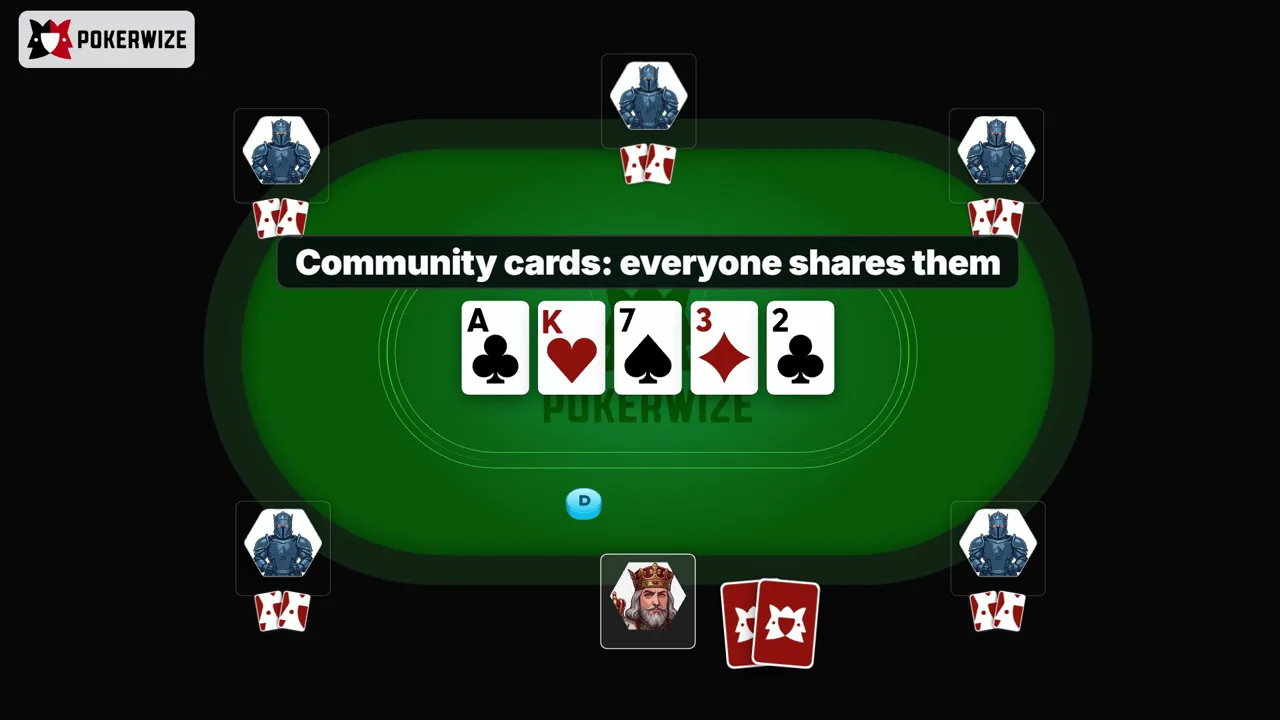
Hold’em uses one ordinary deck of 52 cards. Every player gets two cards, face down: your hole cards, and only you get to look at them. Then five more cards go face up in the middle. These are the community cards, and everyone shares them. Your hand is the best five out of all seven: your two, plus those five.
How many players: cash games and tournaments
At one table, anywhere from two players up to a full table of nine. There are two main ways to play. A cash game is one table: you can sit down, or get up and leave, whenever you like. A tournament can be many tables at once, sometimes hundreds of players, and it runs until one player has all the chips. Either way, a hand plays the same way. The examples here use six players.
The dealer button
The dealer button is a small puck that shows who the dealer is, and it moves one seat to the left after every hand. Who actually handles the cards depends on where you play: at home it’s usually the player with the button, in a casino it’s a house dealer who doesn’t play, and online the software does it. Everything about who acts when is worked out from the button.
The blinds: sizes, and why they exist
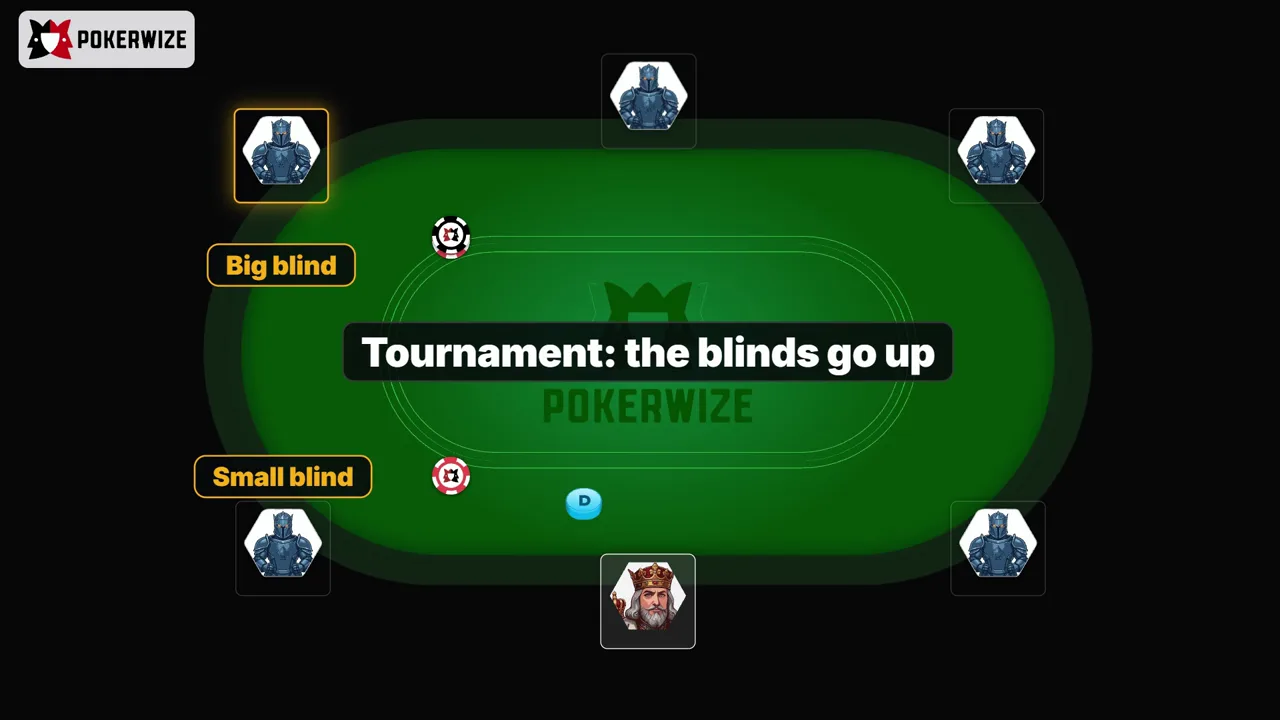
Before any cards come out, two players have to put chips in the pot blind, meaning before they’ve seen a thing. The player to the left of the button puts in the small blind. The next player puts in the big blind, which is usually about double. Cash games are named after these two sizes: fifty cents and a dollar, one-three, two-five and so on. In a tournament, the blinds keep going up as it goes on.
Why have blinds at all? To force money into the game, so there’s always something in the pot to fight for.
Four rounds of betting: preflop and postflop
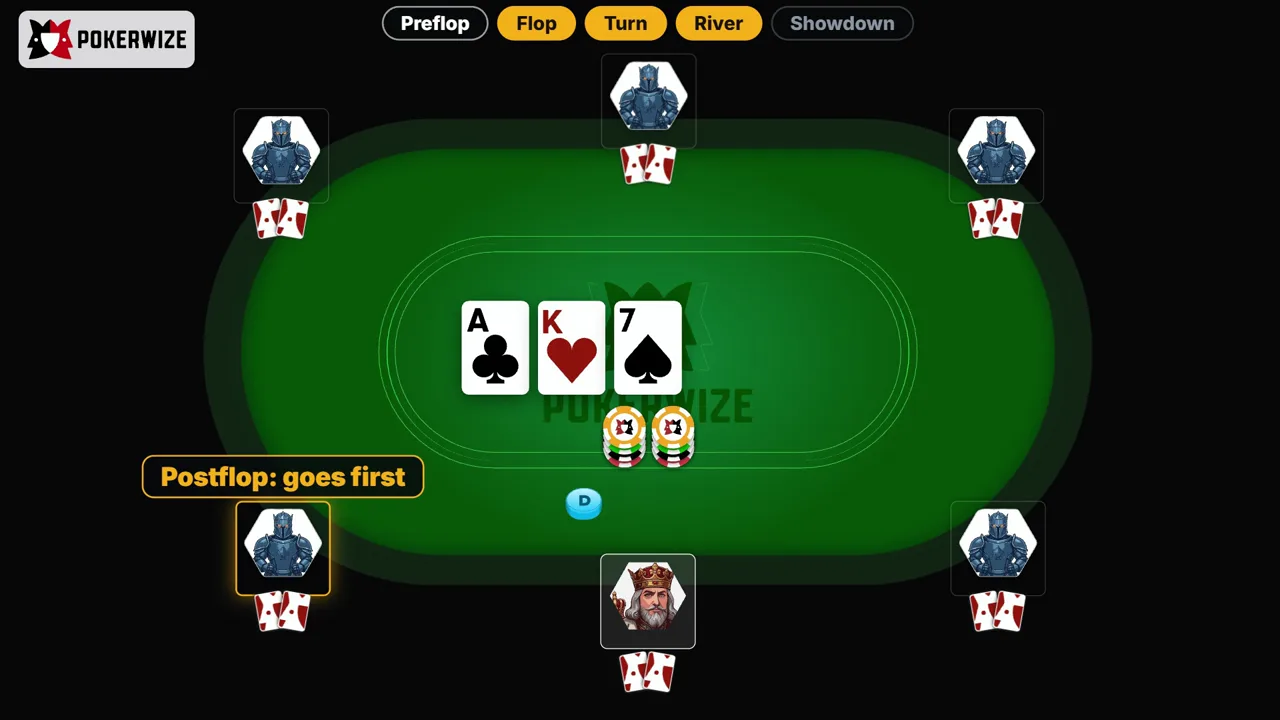
The first round is called preflop: right after you get your two cards, before any community cards. Then three community cards come together, the flop, and round two. One more card, the turn, and round three. The last card, the river, and the final round. Everything from the flop on is called postflop.
Your choices: check, bet, fold, call, raise
On your turn you only have a few choices. If nobody has bet, you can check, which just means pass, or bet. If somebody has bet, you can fold (give up your cards and the pot), call (match the bet) or raise (put in more). Preflop, the big blind already counts as a bet.
Who goes first
Preflop, the player to the left of the big blind acts first. Postflop, it’s the first player still in to the left of the button. So after the flop the button acts last, which is an advantage: you see what everyone else does first. That’s what position means.
The showdown
If two or more players are still in after the final round, that’s the showdown: they turn their cards face up, and the best five-card hand wins.
Let’s play a hand
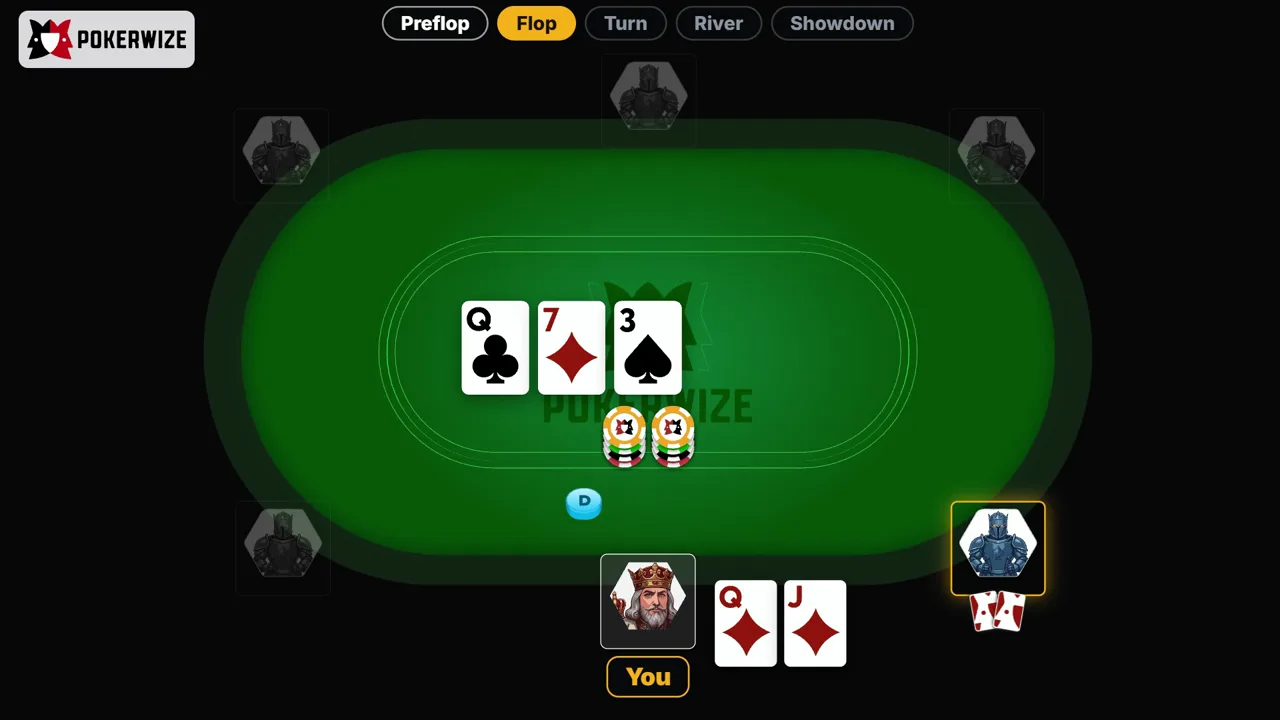
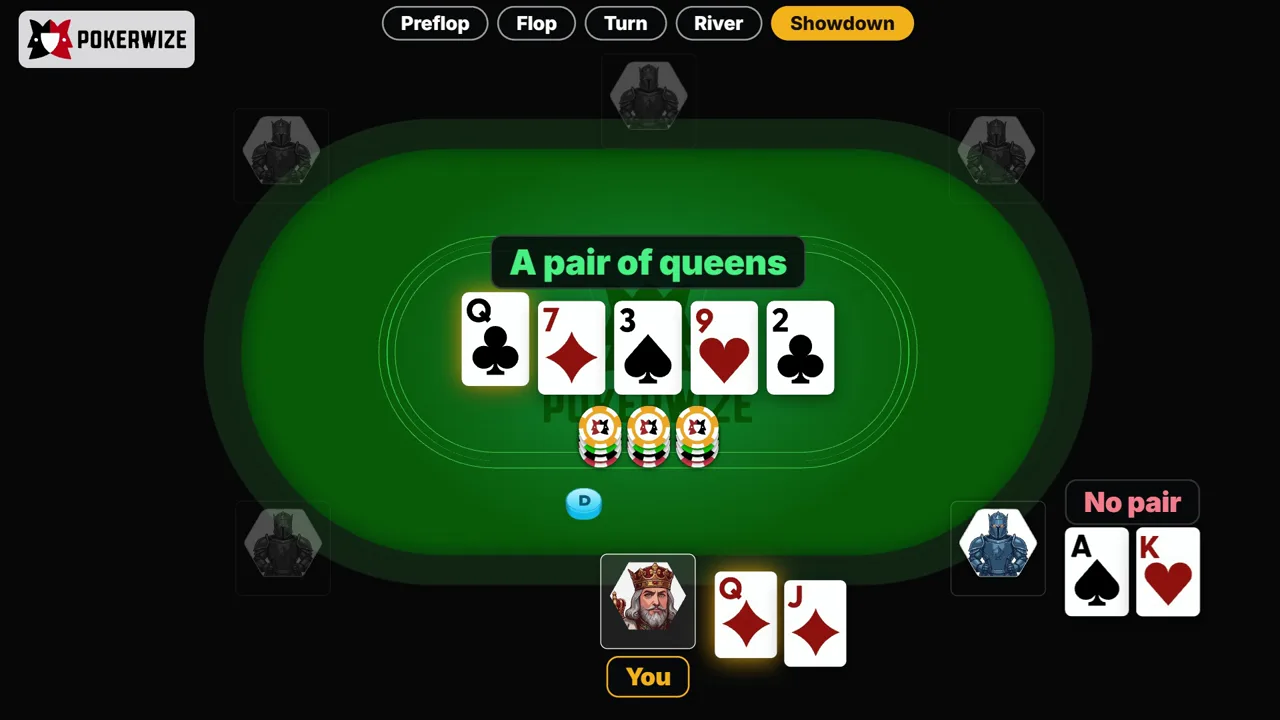
You have the button this hand. The two players to your left put in the blinds, and everyone gets two cards. You look down at the queen and jack of diamonds: two high cards of the same suit. A good start.
Preflop, the first two players fold. The player right before you raises: they probably like their hand, but you can’t see their cards. You call. The small blind folds, and so does the big blind. That leaves the two of you.
The flop comes the queen of clubs, the seven of diamonds and the three of spades. A queen in your hand and a queen on the table make a pair of queens: two cards of the same rank.
Now you’re postflop. Your opponent is the first player still in to the left of the button, so they act first, and they bet. You have the button, so you act last, and you call. The turn is the nine of hearts, and you both check. The river is the two of clubs: five cards in the middle and no more coming. You both check again.
Who wins? Pause and decide
Two of you are still in after the final round, so it’s a showdown. Your opponent shows the ace of spades and the king of hearts, two of the highest cards in the deck. Before you read on, decide: who wins this pot?
Their best five cards are the ace, the king, the queen on the table, the nine and the seven. No pair, nothing. Your best five are your queen, the queen on the table, your jack, the nine and the seven: a pair of queens. A pair beats no pair, so you win the pot, even against ace-king.
Texas Hold’em in one sentence
Two cards each, five in the middle, four rounds of betting, and the best five-card hand wins, unless everybody else folded first. But if a pair beats no pair, what beats a pair? There’s a whole ladder of hands, and that’s Episode 2, hand rankings.
We believe the best way to learn this game is to throw yourself into hands until you really understand them, and to watch as much as you can along the way. When you’re ready to play, you can create a private table at PokerWize and play with your friends for free.
Key takeaways
- Every player gets two hole cards; five community cards are shared, and your hand is the best five of all seven.
- The small and big blinds go in before any cards, so there is always something in the pot.
- Four betting rounds: preflop, the flop, the turn and the river. After the flop, the button acts last.
- You win the pot at the showdown with the best five-card hand, or earlier when everyone else folds.
Learn. Play. Master.
Put it into practice: start training for free at www.pokerwize.com.