What beats what in poker?
From lowest to highest: high card, one pair, two pair, three of a kind, a straight, a flush, a full house, four of a kind, a straight flush and a royal flush. The rarer the hand, the higher it ranks, and your hand is always your best five cards.
Episode 2 of Hold’em 101, written out for people who’d rather read than watch. In Episode 1, a pair of queens beat ace-king, because a pair beats no pair. That left a question: what beats a pair? Here’s the whole ladder, then three showdowns for you to call.
The cards: the two up to the ace
A deck has 52 cards, and every card has a rank. There are 13 ranks. The two is the lowest, then the three, four, five, six, seven, eight, nine and ten, then the jack, the queen and the king, and the ace is the highest card in the deck. Card against card, the higher rank wins: a king beats a queen, and a ten beats a nine. The ace has one trick, which comes up with straights.
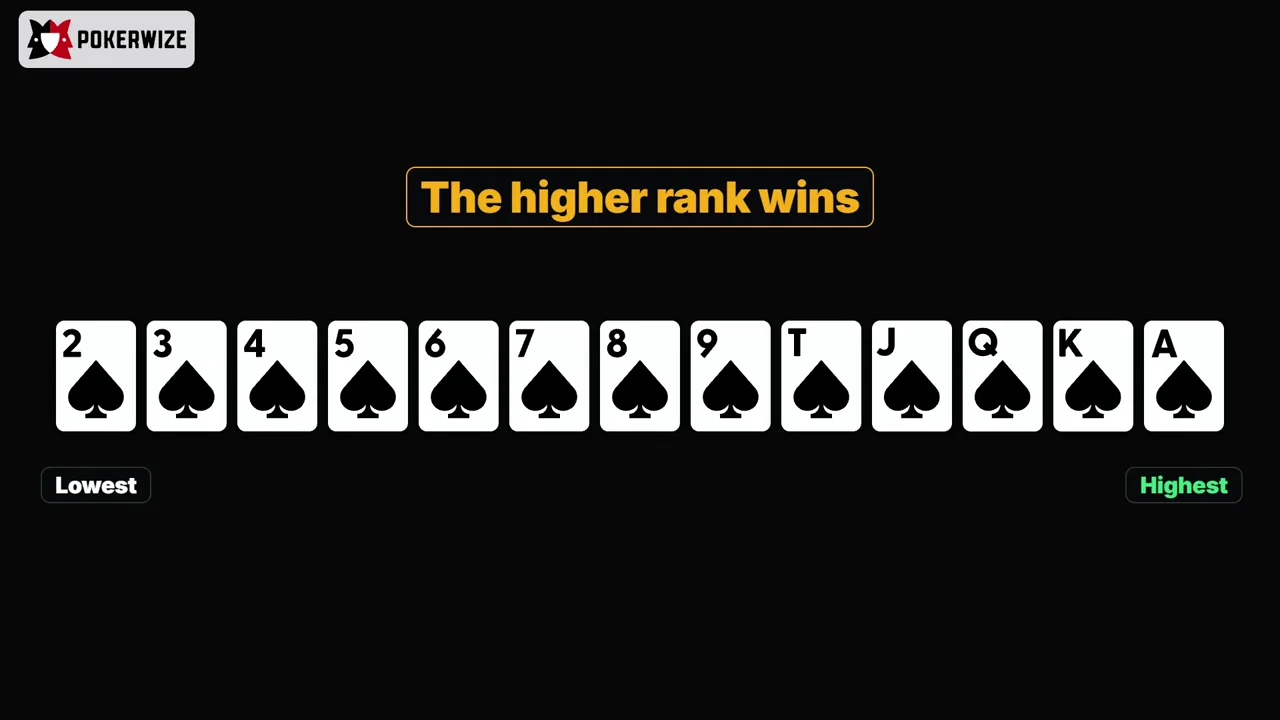
The four suits: none is better
Every card also has a suit, and there are four: spades, hearts, diamonds and clubs. New players often ask if one suit beats another. In Texas Hold’em, no suit outranks any other, so the ace of clubs is worth exactly the same as the ace of spades. A suit only does one job: five cards of the same suit make a hand of their own.
A hand is always five cards
A poker hand is always exactly five cards. You get seven to choose from, your two plus the five in the middle, and your hand is the best five. You can use both of your cards, just one, or even none of them.
The ladder follows how rare each hand is in five cards: the rarer the hand, the higher it ranks. About half of all five-card hands are just high card, and 42% are one pair. A royal flush comes about once in 649,740. Keep that idea in your head and you’ll rarely mix two hands up.
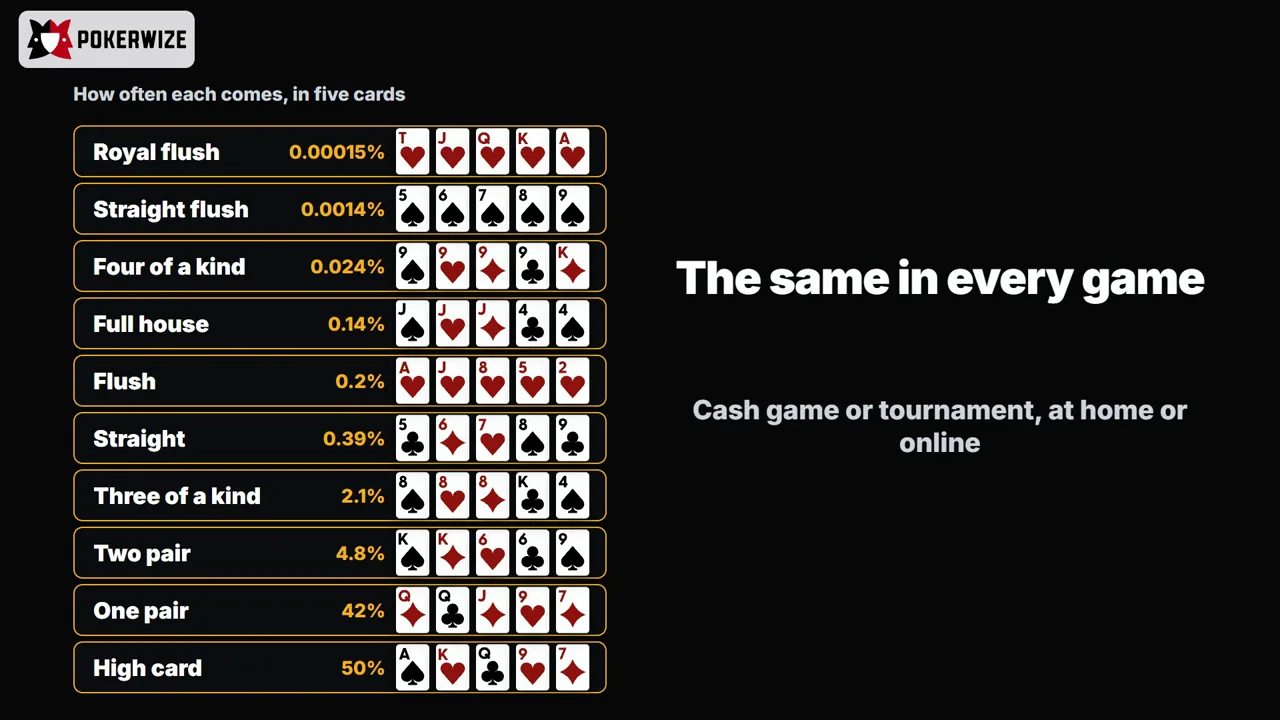
The five everyday hands
High card is at the bottom: no pair, nothing lining up, so your best card is all you’ve got. That’s what ace-king had in Episode 1: ace high.
One pair is two cards of the same rank, like those queens. A pair of aces is the best pair, and a pair of twos is the worst.
Two pair is exactly what it sounds like: two different pairs, like kings and sixes.
Three of a kind is three cards of the same rank. And yes, three of a kind beats two pair, even though two pair sounds like more.
The best of the everyday hands is a straight: five cards in a row, in any suits. An ace can sit at either end, so ace, two, three, four, five works (it’s called the wheel), and so does ten, jack, queen, king, ace. But a straight can’t wrap around the corner: queen, king, ace, two, three is not a straight.
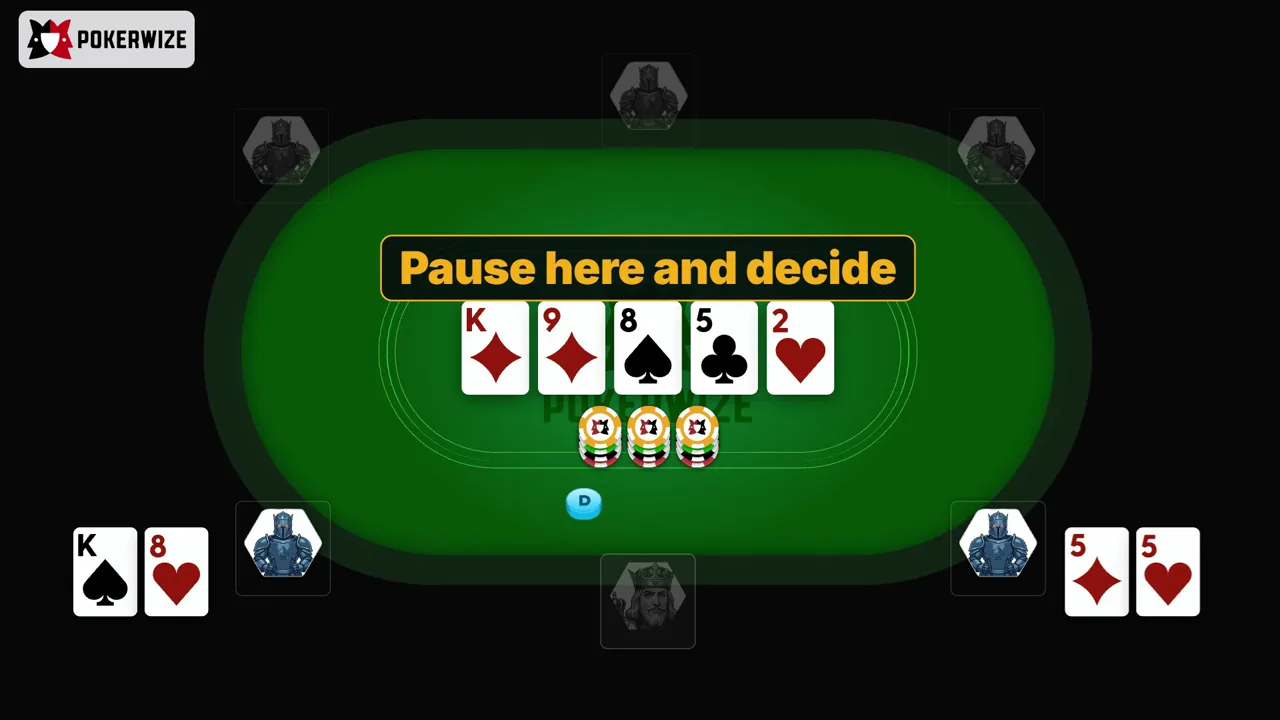
Test one: who wins?
The middle is the king of diamonds, the nine of diamonds, the eight of spades, the five of clubs and the two of hearts. One player holds the king of spades and the eight of hearts. The other holds the five of diamonds and the five of hearts. Decide before you read on.
The first player has two pair, kings and eights. The second player has three fives. Three of a kind beats two pair, so the second player wins.
The five big hands
You’ll see these less often, and when you do, they usually win. A flush is five cards of the same suit, in any order, and it beats a straight. A full house is three of a kind plus a pair, like three jacks and two fours, and it beats a flush. Four of a kind is all four cards of one rank, and only two hands beat it. A straight flush is five in a row, all in the same suit. And at the very top, the royal flush: ten, jack, queen, king, ace, all in the same suit. Nothing beats it, though you shouldn’t wait around for one.
That’s the ladder, and it’s the same in every game of Hold’em: cash game or tournament, at home or online. You don’t have to learn it in one sitting. Keep the hand rankings chart in our rulebook next to you for your first few games.
When two players have the same hand
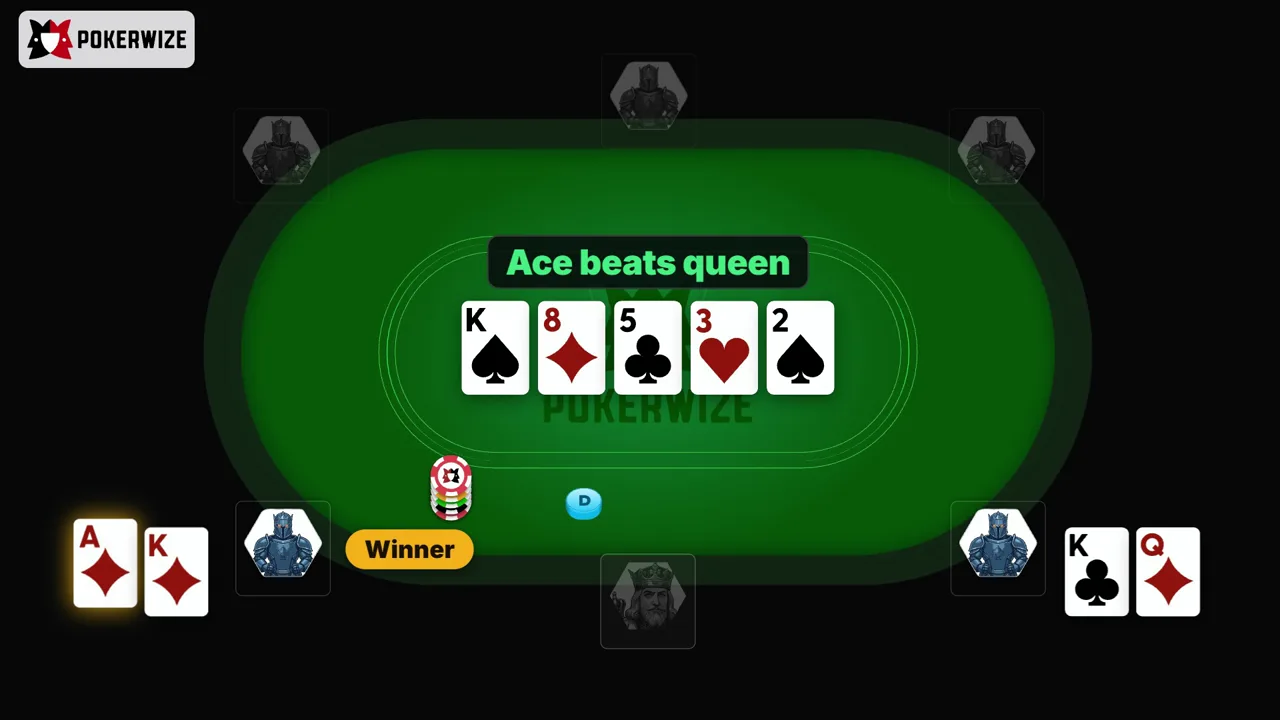
Say there’s a king in the middle. One player holds ace-king, and the other holds king-queen. Both have a pair of kings, so the next highest card decides it. That card is called the kicker. Ace beats queen, so ace-king wins this time.
The same idea runs all the way up the ladder. Two straights: the board has the nine, ten and jack, one player holds king-queen and the other holds eight-seven. Both have a straight, but one runs up to the king and the other only up to the jack, and the straight that reaches higher wins.
Two flushes: three hearts land on the board, one player holds the ace and three of hearts, the other holds the king and queen of hearts. Both have five hearts. The suit can’t decide it, so the cards do: the flush with the highest card wins, ace high over king high. If the highest cards match, you go to the next card down.
Two full houses: the three of a kind counts first, so three queens with two fours beats three jacks with two queens. And if two players end up with exactly the same five cards by rank, they split the pot. Suits never break a tie.
Playing the board
The five cards in the middle are also called the board, and sometimes the board is the best hand anyone can make. Say it’s ten, jack, queen, king and ace in mixed suits, with no three of one suit. That’s the best straight there is, and nobody can beat it. That’s called playing the board, and everyone still in the hand splits the pot.
Tests two and three
Test two. The board is the four, nine, jack and two of hearts, and the queen of clubs. One player holds the ace of hearts and the seven of spades. The other holds the king and queen of hearts. Who wins? Both players have five hearts, so both have a flush. The second player used two of their cards and the first player only one, but that makes no difference: the first player’s flush is ace high, the second player’s is king high, and ace high wins.
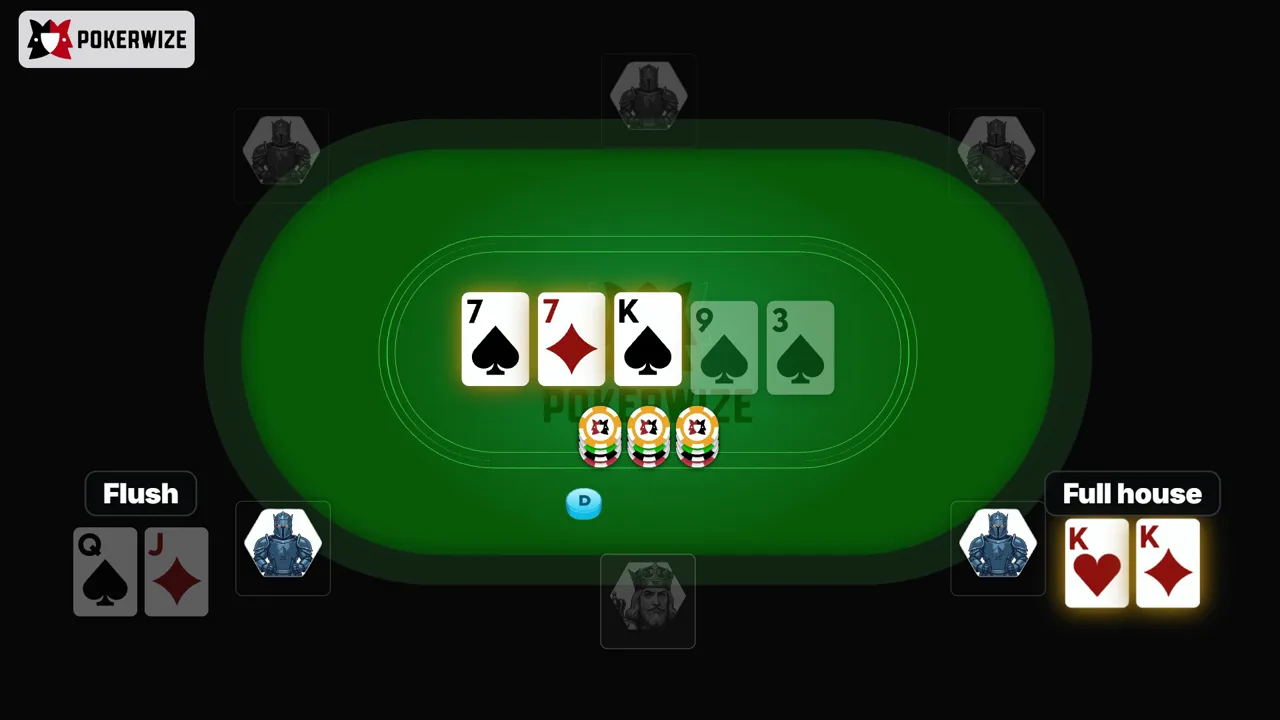
Test three, a tricky one. The board is the seven of spades, the seven of diamonds, the king of spades, the nine of spades and the three of spades. One player holds the queen of spades and the jack of diamonds. The other holds the king of hearts and the king of diamonds. The first player has five spades: a flush. But the second player has three kings and two sevens: a full house. A full house beats a flush, so the second player wins.
What you never see at a real table
In every example here you saw both players’ cards. At a real table, you never see them until the end. So good players don’t try to guess one exact hand: they think about every hand the other player could have. That’s called a range, and it’s where our Pro Mindset series starts (Episode 1).
Next in Hold’em 101, back to the table: the button, the blinds and who acts first (Episode 3). When you’re ready to play, you can create a private table at PokerWize and play with your friends for free.
Key takeaways
- High card, one pair, two pair, three of a kind, straight, flush, full house, four of a kind, straight flush, royal flush: the rarer the hand, the higher it ranks.
- A hand is always your best five cards. Suits never rank; they only make flushes and straight flushes.
- Same kind of hand? Compare the hand itself first: the higher pair, the higher straight, the flush with the higher cards. Only when that ties does the kicker decide, and the same five ranks split the pot.
Learn. Play. Master.
Put it into practice: start training for free at www.pokerwize.com.