How do you stop guessing your opponent’s hand?
Don’t pick one hand. Work out the whole range: every hand they could hold, given where they sit and what they’ve done. Then count combos, the number of ways each hand can be dealt, to see which hands are actually likely.
This is Episode 1 of the Pro Mindset series, written out for people who’d rather read than watch. The numbers come from computer solvers (programs that play poker against themselves, over and over, until they find an optimal strategy, known as GTO). PokerWize runs its own solves, and everything here comes from the PokerWize GTO data or from simple counting.
The guess
Picture a hand. Someone raises in front of you and you tell yourself: “I think they have Ace-King.” It feels like skill when you’re right, but even then it was a guess: one hand picked out of everything they could be holding. This episode swaps that guess for a method, and follows one hand from start to finish: your guess of Ace-King against a raise.
What a range really is
Amateurs say, “I think they have this exact hand.” Professionals ask, “What could they be holding, and how often?” The first is a statement, which shuts your thinking down. The second is a question that works with the information you actually have.
That question has a name: a range. A range is every hand a player could hold, given where they sit and the action they’ve taken so far. Think of it as a cloud of possible hands. Your job isn’t to pull one hand out of the cloud; it’s to figure out which hands are in it.
A range is also more than a list, because each hand comes with a frequency: how often that player takes this action with it. From under the gun, pocket aces get raised every time. Eight-seven suited only gets played now and then. Seven-deuce offsuit never does.
Why your seat matters
In this example, the table has six seats, and each has a name. The first player to act before the flop is under the gun (UTG), then the hijack, the cutoff, the button, and the two blinds. The seat matters because you learn from everyone who acts before you, and your options are shaped by how many players are still behind you: five behind you under the gun, four from the hijack, three from the cutoff, and two from the button. Every player behind you is one more chance that somebody wakes up with a big hand, so the earlier you sit, the more careful you have to be.
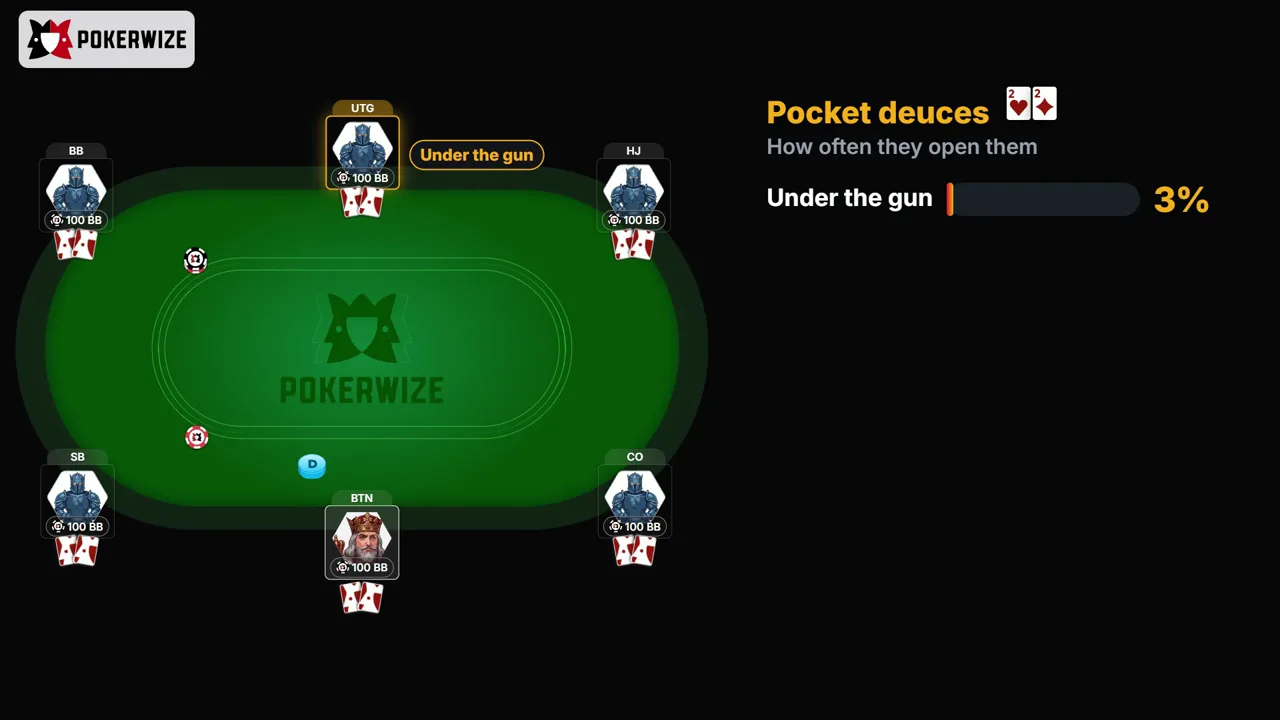
Take pocket deuces with nobody in the pot yet. In the PokerWize GTO data they open 3% of the time from under the gun, 20% from the hijack, about half (53%) from the cutoff, and 100% from the button. Same hand, four seats, four very different answers. And it isn’t just one hand: the whole range grows as you move to later seats. Under the gun opens about 17% of all hands; the button opens 43%.
How to read a range chart
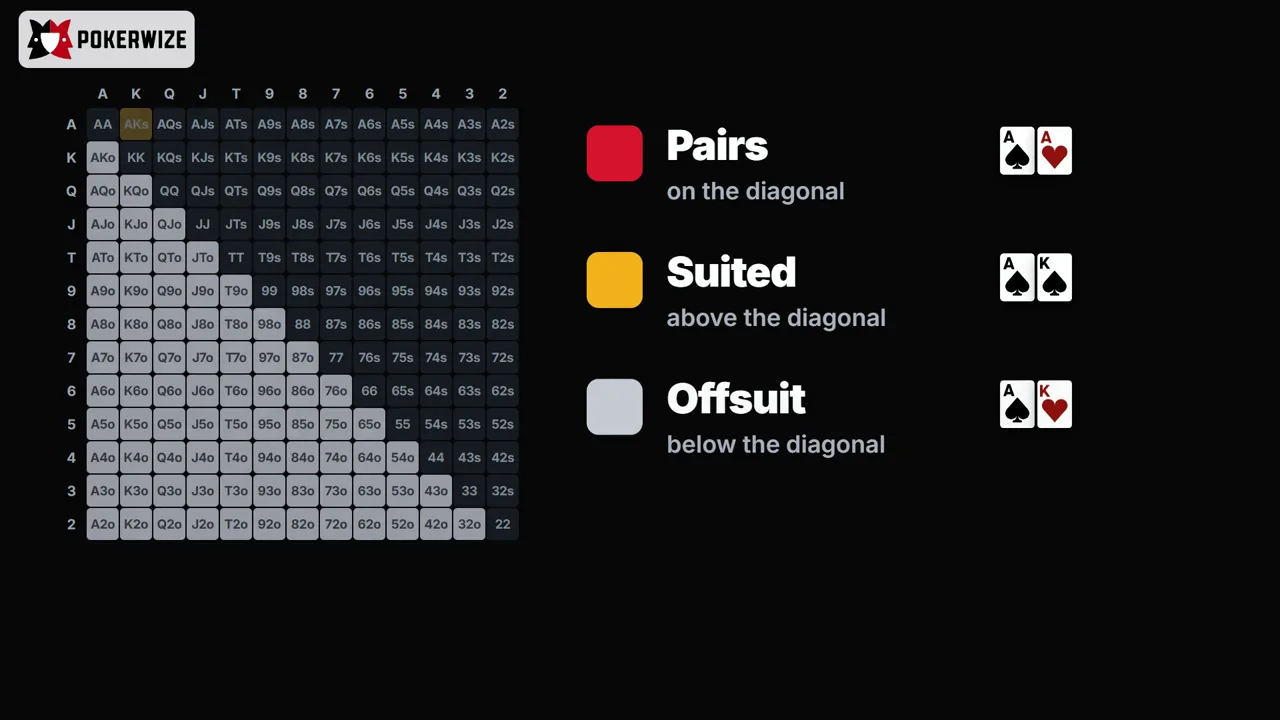
To see a whole range at once, we use a range chart: a 13 by 13 grid where every square is one kind of starting hand, from ace down to deuce across the top and down the side. Pairs sit on the diagonal, suited hands above it, offsuit hands below it. That makes 169 different starting hands. The color of a square tells you how often the player takes the action: bright means almost always, dark means almost never.
Types of ranges
Not every range is the same kind of range, because a range depends on what has already happened in the hand. Two matter in this episode. The opening range is RFI, raise first in: everyone before you folded and you’re the first to put chips in. The calling range is what you call with after someone has opened; one raise and one call makes a single raised pot, or SRP, and it has its own chart. The rest get a quick name: a limp (calling the big blind), an isolation raise (a raise over a limper), a three-bet (a re-raise of the opener), a squeeze (a re-raise after a raise and callers), a four-bet and a five-bet.
Comparing ranges
Put two opening ranges side by side and the table’s lesson shows up on the chart. From under the gun the range is a small bright patch in the top left. On the button it spreads across the chart and holds every pocket pair.
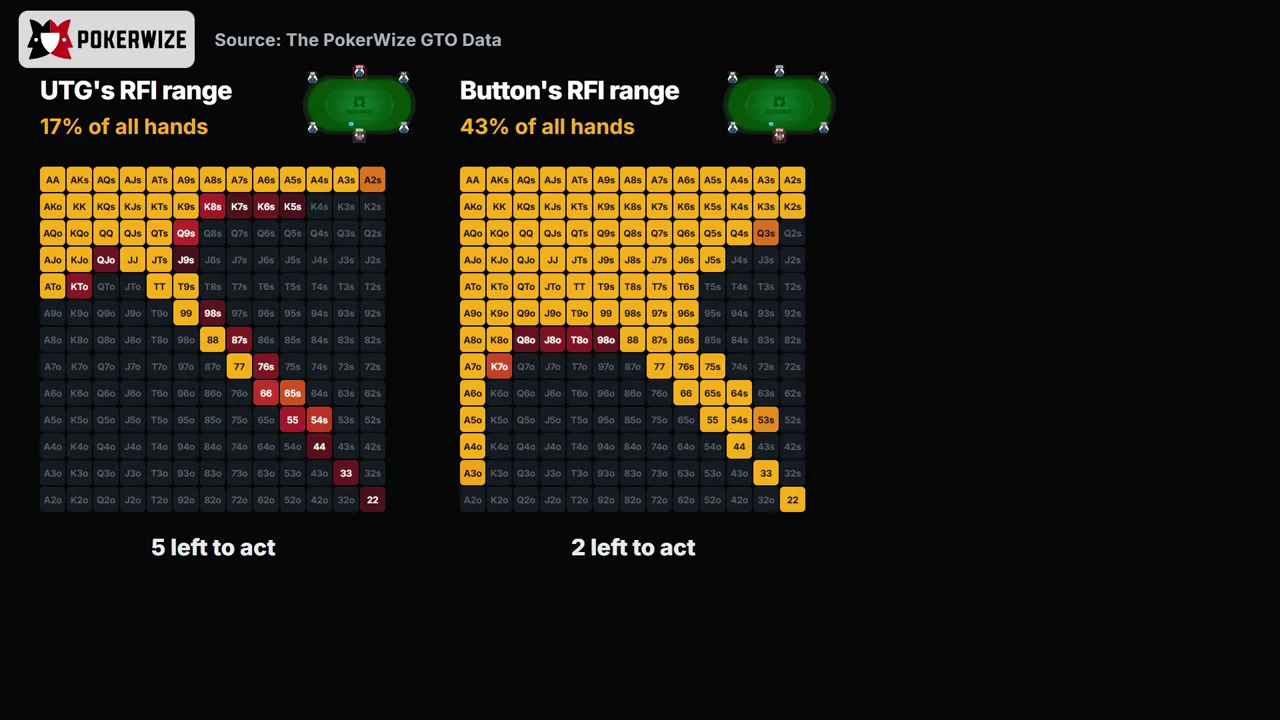
One trap: the button’s RFI range is what the button opens when everyone folds to them. It isn’t what they play against an under-the-gun raise. Once someone raises, you reach for a different chart, a calling range or a three-bet range. Against an under-the-gun open, the button continues with only about 11% of hands, not 43%.
Counting combos
A square is a type of hand, but there are several ways to deal each one, depending on the suits. Each way is a combo. There are four aces in the deck and a pair uses two of them, so pocket aces have 6 combos. Ace-King is four aces times four kings: 16 combos, 4 suited and 12 offsuit. That makes Ace-King more than two and a half times as likely as pocket aces. The whole deck holds 1,326 combos, so every range is just a share of that number.
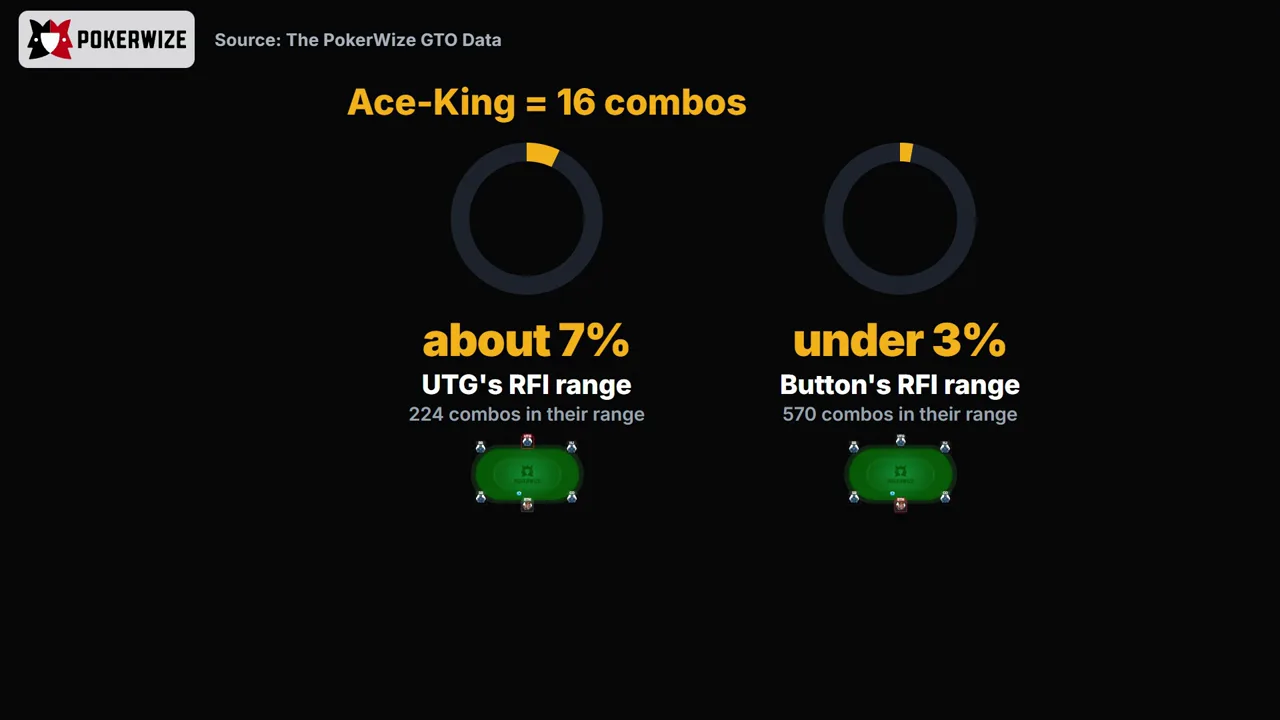
Back to your guess. Under the gun’s opening range holds about 224 combos, and Ace-King is 16 of them, about 7%. The button’s range holds about 570 combos, so Ace-King is under 3%. Whatever hand you name, they can hold a lot of others. A shortcut while playing is subtraction: every card you can see removes combos. If you hold an ace yourself, they have only 3 ways to hold pocket aces, not 6.
Playing out the hand
Now the hand, in order. Under the gun raised from their opening range. The hijack and the cutoff folded, you called on the button, and the blinds folded. The flop came the ace of spades, the seven of diamonds and the deuce of clubs, and under the gun bets. The order matters: the seat first, then their action, then the board. Each step removes hands from their range.
To keep it simple we track three hands: your guess of Ace-King, plus pocket aces and pocket deuces as reference. With an ace on the board, Ace-King is 3 aces times 4 kings, 12 combos. Pocket aces, now three of a kind, are 3 combos. Pocket deuces almost never appear in an under-the-gun range (3%), so the three of a kind we’re tracking adds up to about 3 combos against 12 for Ace-King. Your guess was the more likely story, with about four times as many combos, but three of a kind is still in there.
Change the seat and the story changes. If the same raise came from the cutoff, pocket deuces are in the range about half the time, so three of a kind grows to about 5 combos while Ace-King stays at 12. Same board, different seat, different answer. One caution: this counts only three hands and ignores your own cards. In a real hand you’d subtract what you hold too.
Range advantage
You called on the button, so your range differs from theirs: theirs is under the gun’s opening range, yours is the button’s calling range in a single raised pot. When one range connects with the board more strongly, that player has a range advantage. Count the share of each range holding two pair or better. On ace, king, deuce, the opener has it about 9% of the time and your calling range about 2%. On eight, seven, six it flips: the opener about 7%, your calling range about 14%. Same two players, same two ranges, different board.
Three questions to ask
Their seat sets the size of their range, the chart shows which hands are in it, combos tell you how often each hand shows up, and their bets narrow it further, street by street. The count doesn’t tell you what to do; it tells you what to weigh. So next time you catch yourself saying “I think they have Ace-King,” ask three questions.
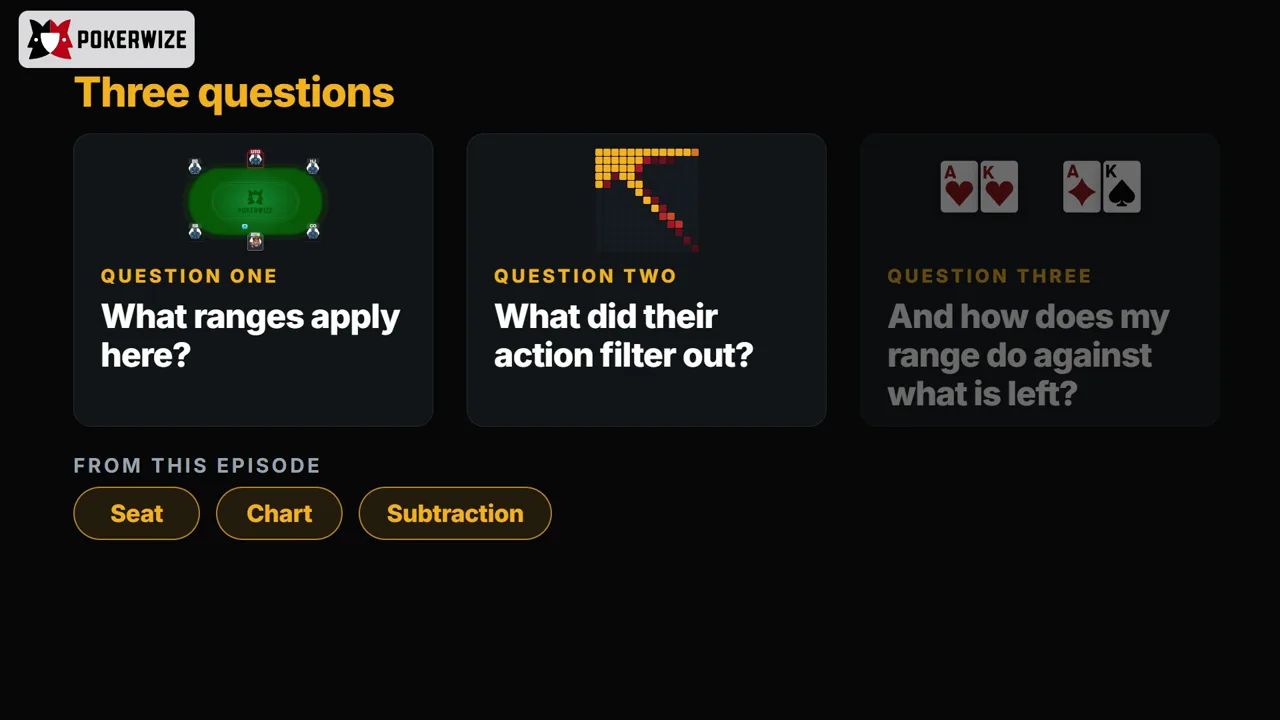
What ranges apply here: the seat and the action. What did their action filter out: the hands they wouldn’t play this way. And how does my range do against what’s left? That’s how guessing becomes knowing. Count combos, not hands.
Key takeaways
- A range is every hand they could hold, given their seat and their action, each with a frequency.
- Later seats play wider: pocket deuces open 3% of the time under the gun and 100% on the button.
- Count combos: Ace-King is 16, a pocket pair is 6, and every card you can see removes combos.
- Each step (seat, action, board) removes hands from their range. Weigh the count; don’t pick a hand.
Learn. Play. Master.
Put it into practice: start training for free at www.pokerwize.com.