Can winning a poker pot be a mistake?
Yes. Winning the pot grades the result, not the decision. Pros grade a decision by its expected value (EV): what it is worth on average if you could make it over and over. A play can win the pot and still lose chips in the long run.
Episode 2 of the Pro Mindset series, written out for people who’d rather read than watch. The poker numbers come from GTO solves, computer programs that play poker against themselves until they find an optimal strategy; the rest is simple arithmetic. Episode 1 covered ranges.
You’ve heard it at the table
“Poker is just luck, and nobody makes money at it in the long run.” That’s the amateur talking. The amateur says, “I always lose with aces.” The pro says, “I was an 82 percent favorite, and this was one of the 18.” The amateur says, “I’m up for the night.” The pro says, “Three hard spots: two I played well, and one I’d play differently.” Luck decides a night. Your decisions decide the long run.
The hand that won the pot
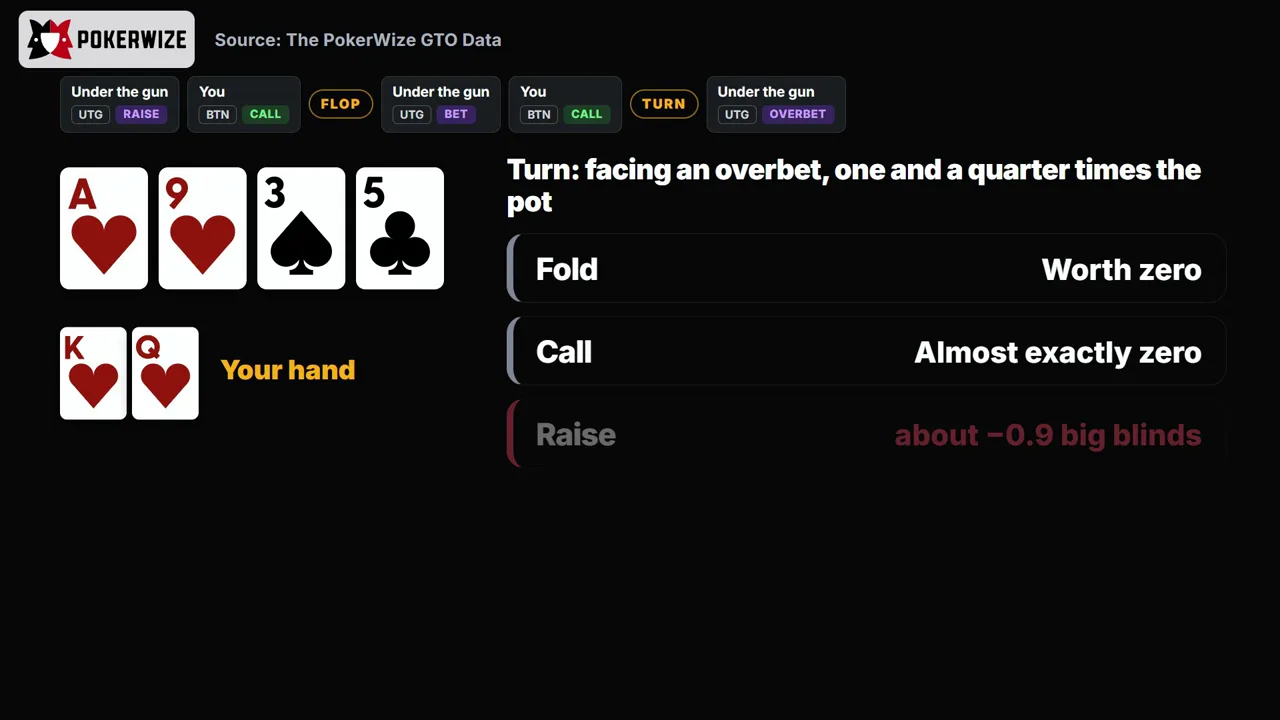
We pick up where Episode 1 left off, with a different runout. Under the gun raises, the hijack and the cutoff fold, and you call on the button with king-queen of hearts. The blinds fold. The flop comes the ace of hearts, the nine of hearts and the three of spades. They bet a third of the pot and you call. The turn is the five of clubs and they bet big, more than the whole pot. You put the pressure back on and raise. They fold and you take it down.
Great play? Here’s the problem. According to GTO, that raise loses money in the long run. Under the gun folds to it about half the time, and it still costs you about a big blind, on average, every time you make it. You won the pot and made a mistake, in the same hand. Think of insurance in blackjack: the dealer shows an ace, you take insurance, and the dealer flips over 21. You feel brilliant. But insurance pays 2 to 1 and the dealer has blackjack less than a third of the time, so it loses money every time you take it in the long run.
What EV actually is
Expected value, or EV, is what a decision is worth on average if you could make it over and over: every way it could play out, added up and averaged. A decision that makes chips on average is plus EV; one that loses chips on average is minus EV. And measured from the moment you decide, folding is worth zero: you put nothing more in and win nothing more. Every other choice is measured against that zero.
The EV recipe: a coin flip
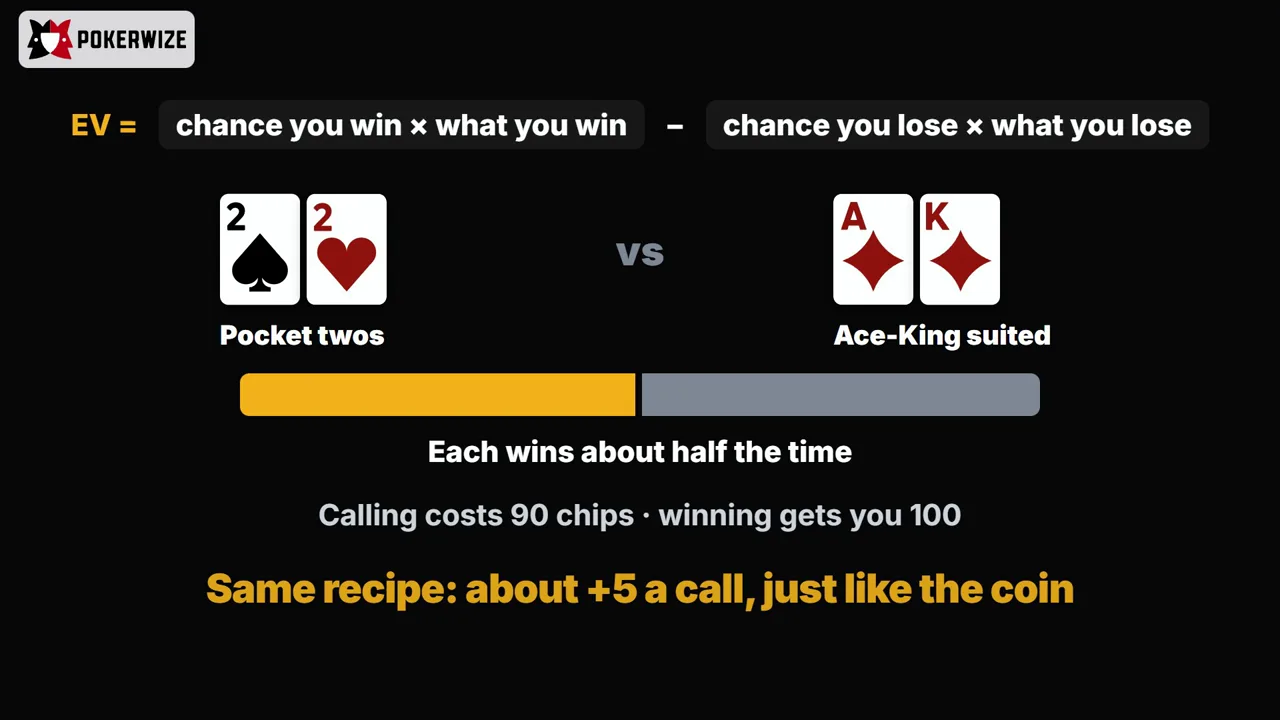
The math is one line: the chance you win times what you win, minus the chance you lose times what you lose. Try it on a coin flip. Heads you win 100 chips, tails you lose 90. Half of 100 is 50, half of 90 is 45, and 50 minus 45 leaves plus 5. Every flip is worth plus 5 chips, not plus 10, because each side only happens half the time. You never actually win 5 on a flip; plus 5 is what your flips average out to in the long run.
Poker has its own coin flip: pocket twos against ace-king suited, all in before the flop. Each hand wins about half the time. If calling costs you 90 chips and winning gets you 100, the same recipe says that call is worth about plus 5, just like the coin.
Now a hand everyone knows: all in before the flop with pocket aces against pocket kings. Aces win about 82 out of 100 times. Play it a hundred times for 100 chips each, win 82, lose 18, and you’re up about 6,400 chips, about 64 a hand. When a king hits the river, the jam wasn’t the wrong move; it was one of the 18.
Grading our hand
Back to king-queen. On the flop, under the gun bets a third of the pot. Folding is never right. Calling is worth about 5.9 big blinds and raising is worth about the same, so GTO mixes them: either is a good decision. On the turn, under the gun overbets one and a quarter times the pot. Folding is worth zero. Calling is worth almost exactly zero too. And your raise loses about a big blind, even though they fold to it about half the time. Of your three choices, the one that won you the pot is the only one that loses money.
The recipe on our raise
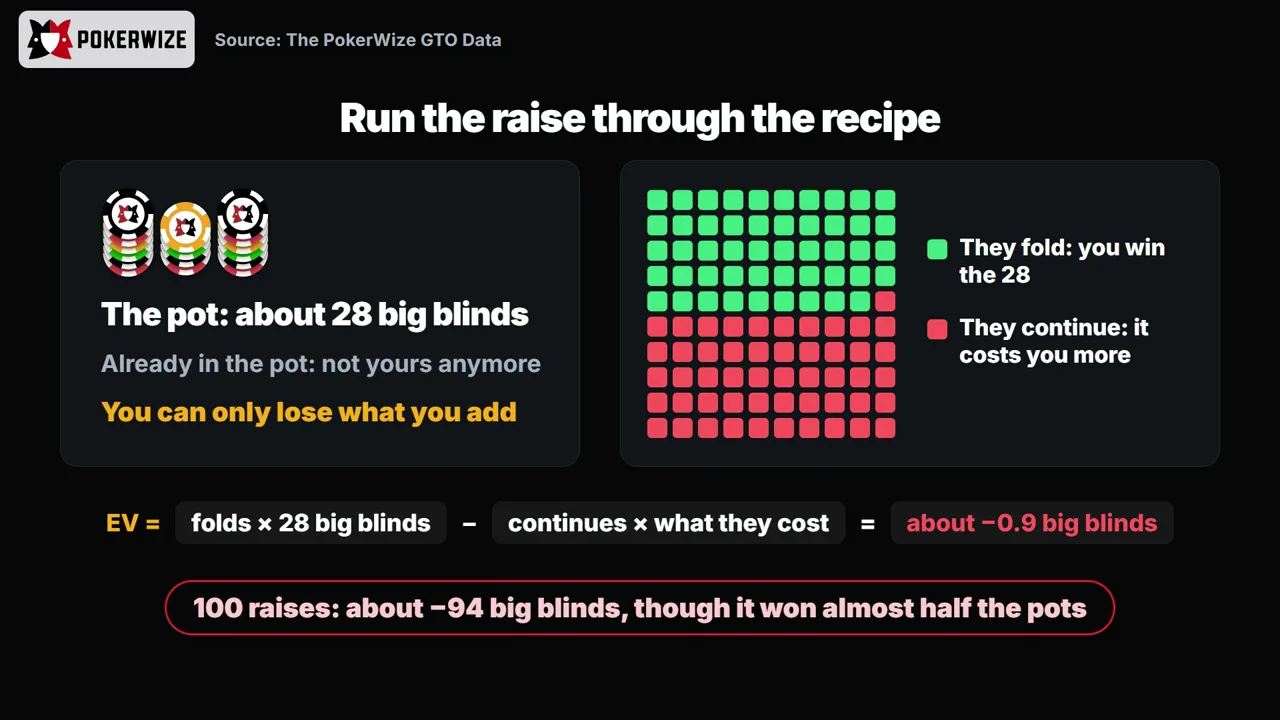
Run the raise through the recipe. By the turn the pot holds about 28 big blinds, counting the overbet. None of those chips are yours anymore, including the ones you put in earlier; from here the only chips you can lose are the ones you add. About half the time they fold and you win the 28. The rest of the time they continue, and those hands cost you more than the folds win you. Add both sides and the raise works out to about −0.9 big blinds. Make it 100 times and you’re down about 94 big blinds, even though it won almost half of those pots.
Why GTO’s call is worth zero
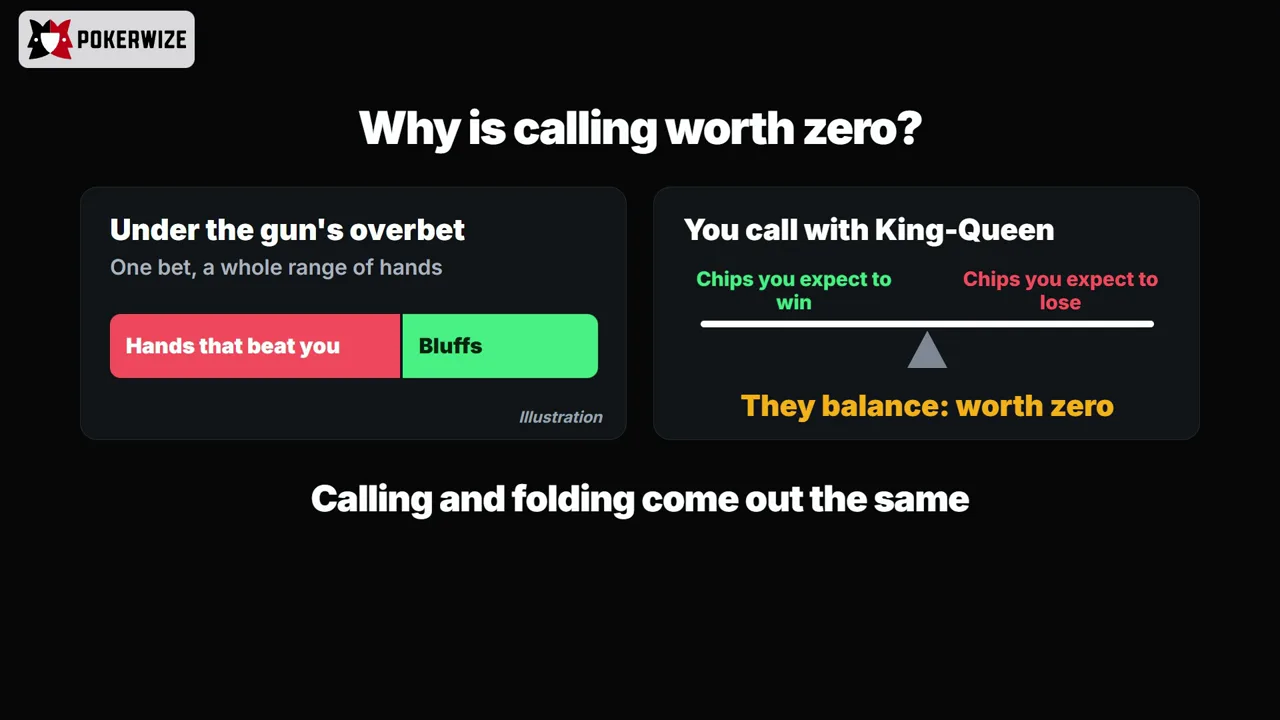
Why would GTO hand you a call that’s worth zero? Because of what under the gun is betting. The overbet isn’t one hand, it’s a range: some hands that beat you and some bluffs. GTO mixes the two so that when you call with king-queen, the chips you expect to win exactly balance the chips you expect to lose. Calling and folding come out the same, and no one can profit by playing differently against it.
Exploitative play
Real players rarely get that mix right, and that’s where good players earn their edge. If you know this player almost never bluffs here, folding king-queen saves you chips. If they bluff too often, calling wins you chips. GTO isn’t a do-or-die rulebook. It’s a reference for finding your opponents’ leaks and exploiting them, and before you can spot what an opponent does wrong, you need to know what right looks like.
Two scorecards
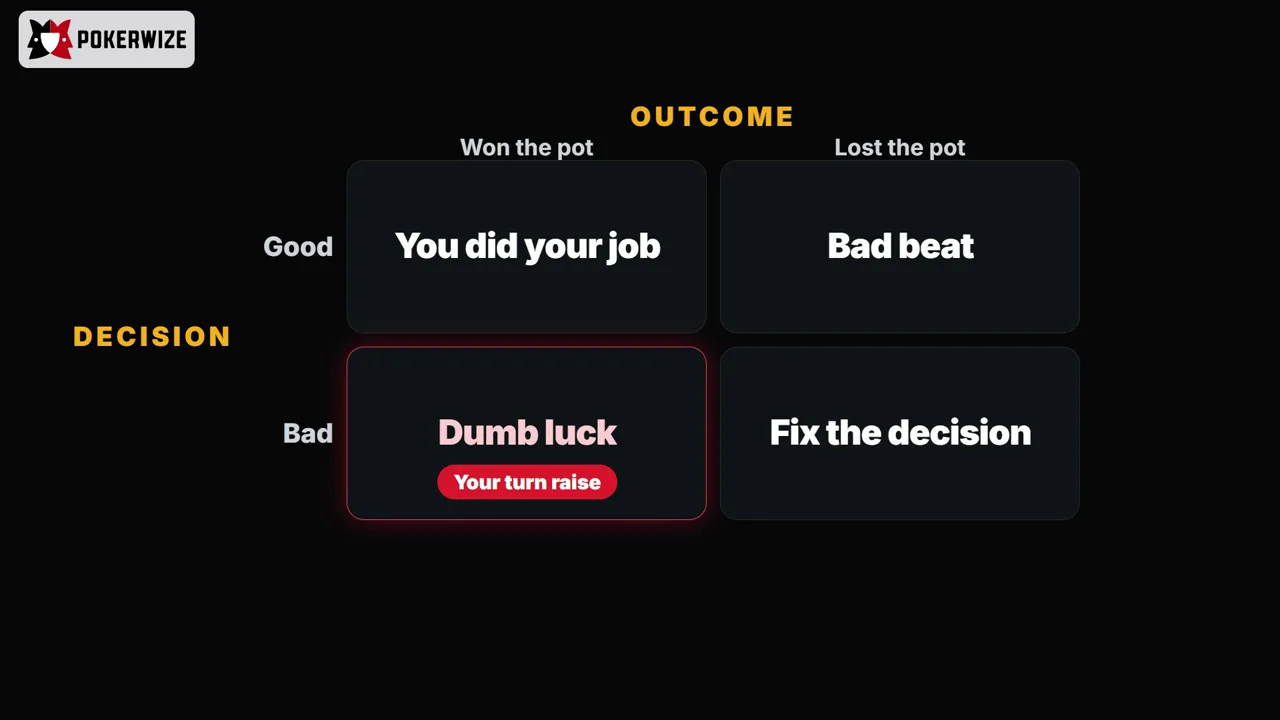
Pros keep score with two scorecards: one grades the decision by its EV, the other grades the outcome, win or lose the pot. Put them together and you get four boxes. Our raise lands in the worst one: a bad decision with a good outcome. That’s dumb luck, and it’s the most expensive box on the board, because it feels exactly like skill. Taking insurance and getting paid lands there too.
One session is noise
That’s why one session tells you almost nothing. A winning player can lose for a week and a losing player can win for a month. Your decisions draw a straight line: what you should earn. The cards draw a jagged line around it: what you actually get. At the table you only ever see the jagged one, and only a big sample of hands brings the two together. A casino doesn’t worry about one lucky blackjack player for the same reason: it can lose hands every night for a month and still come out on top.
Your three hardest decisions
After every session, pick your three hardest decisions, not your three biggest pots, and ask four questions, in this order. What were my options (fold, call, raise, and the sizes)? What did I know then? Only what you knew at the time: the river card isn’t evidence. What was each option worth? Even a rough EV beats a feeling. And would I do it again, yes or no, with the same information? Your job is to make the decisions with the best EV and let the long run pay you. Decision first, result last.
Want to practice hands while seeing the EV of each of your decisions? The PokerWize GTO Trainer shows it live as you play.
Key takeaways
- Expected value is what a decision is worth on average: chance you win × what you win, minus chance you lose × what you lose.
- Folding is worth zero from the moment you decide; every other option is measured against it.
- Our turn raise won the pot and is still worth about −0.9 big blinds, roughly −94 over 100 raises.
- Grade the decision and the outcome separately, and judge yourself on a big sample, not a session.
Learn. Play. Master.
Put it into practice: start training for free at www.pokerwize.com.