What is a c-bet in poker?
A continuation bet, or c-bet, is a bet on the flop by the player who raised before the flop. How often to make it depends on the board: your range advantage there sets how often to bet, and your nut advantage sets how big. It is not a bet to make every time.
Why the raiser bets again
The player who raised before the flop usually holds more of the big hands: big pairs, ace-king, king-queen. On a flop that suits those hands, their whole range is ahead, and a bet makes the other player pay to see more cards. On a flop that suits the caller, the same bet just throws chips away. So the question is never “did I hit?” It’s “which range does this flop help?”
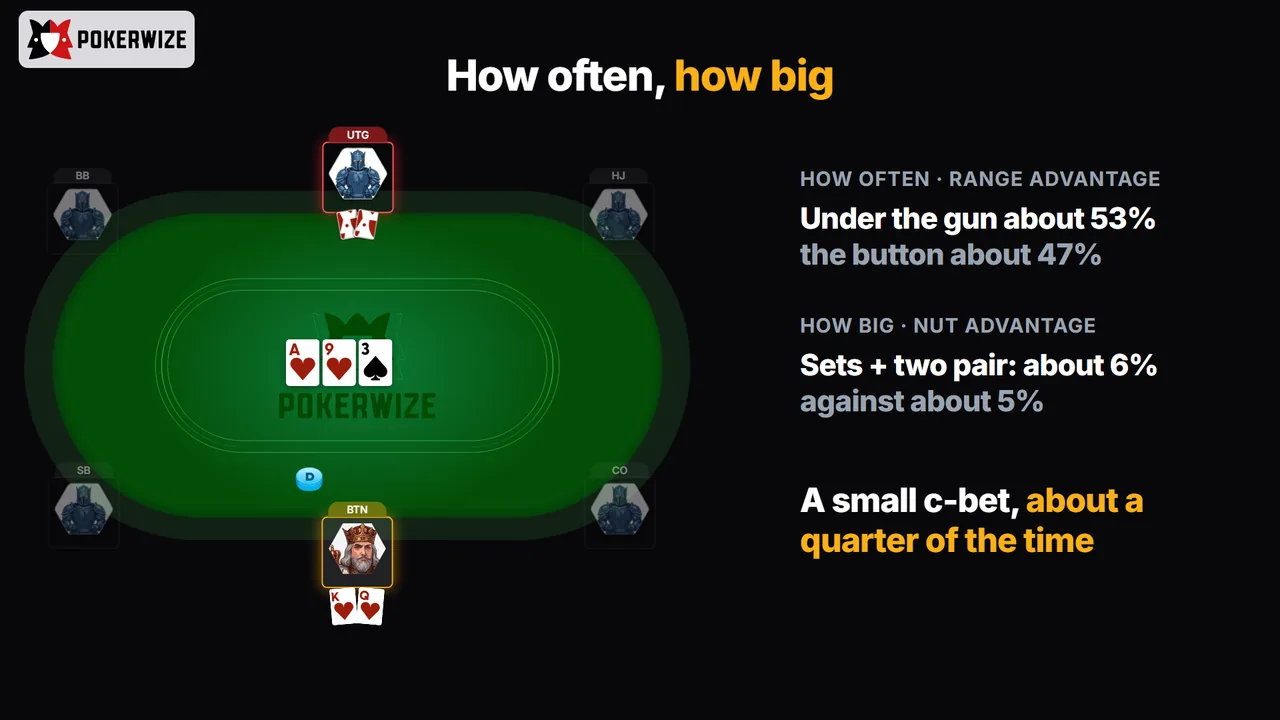
Two answers decide it. Range advantage, the share of the pot each whole range would win, tells you how often to bet. Nut advantage, who holds more of the very best hands, tells you how big.
Three flops, one range
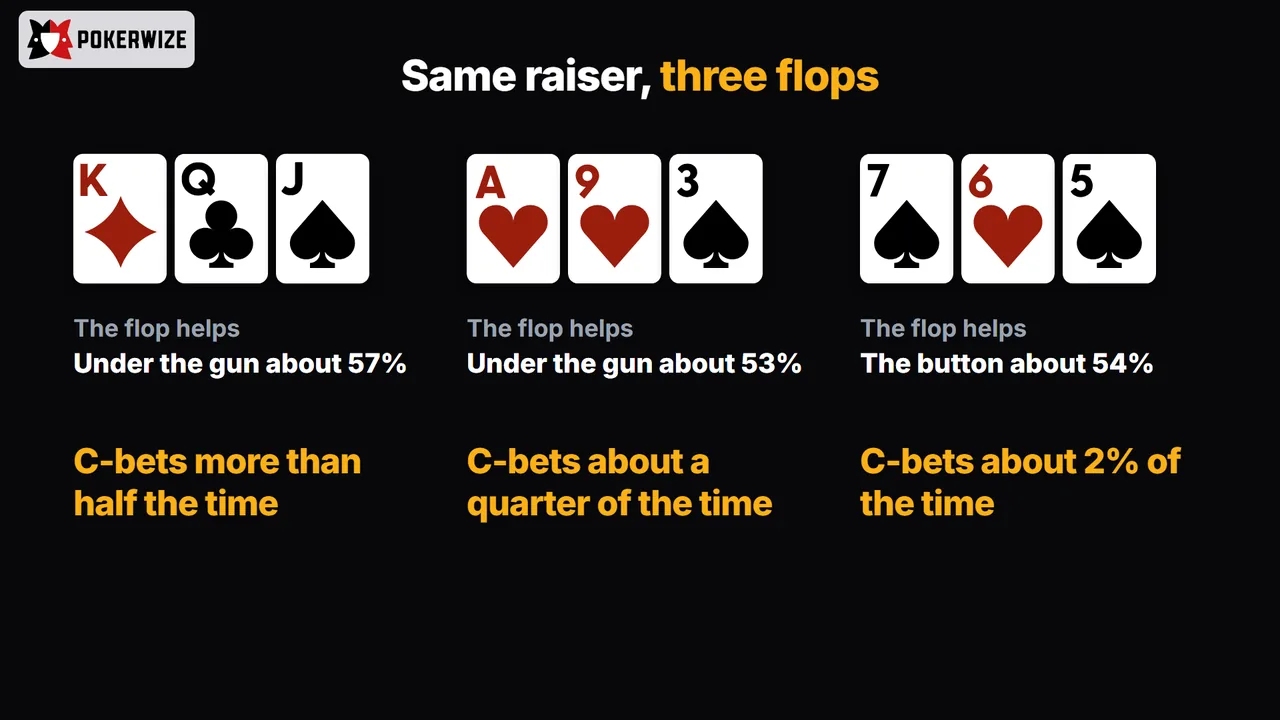
Under the gun raises, the hijack and the cutoff fold, and the button calls; the blinds fold. Same two ranges, three different flops, from the solves in Episode 4:
| Flop | Who the flop helps | How often under the gun c-bets |
|---|---|---|
| King-queen-jack | Under the gun, about 57% | More than half the time |
| Ace of hearts, nine of hearts, three of spades | Under the gun, about 53% | About a quarter of the time |
| Seven-six-five | The button, about 54% | About 2% of the time |
On king-queen-jack, where under the gun wins about 57%, GTO bets more than half the time. On seven-six-five, where the button wins about 54%, under the gun checks almost everything and bets about 2% of the time. On the ace-nine-three flop the edge is small, so under the gun bets only about a quarter of the time, and almost always a third of the pot. Even ace-king, top pair with the best kicker, bets only about half the time.
How big: nut advantage
On the ace-nine-three flop, the best hands are three of a kind and two pair. About 6% of under the gun’s range has one, and about 5% of the button’s: close to even. Under the gun pulls ahead with top pair: about 34% of their range has a pair of aces, against about 26% of the button’s. More good hands but not more great ones, so the bet stays small.
A bet of a third of the pot gives the caller a cheap price: call 1 to win 4, a 20% share of the final pot. That is why a small c-bet works with many hands, and why the caller should rarely fold to it.
Common mistakes
- C-betting every flop. On seven-six-five the raiser bets about 2% of the time. “I raised so I have to bet” isn’t a plan.
- Betting big without the nuts. When both ranges hold about the same share of the best hands, the bet stays small.
- Folding to every small c-bet. A third-pot bet asks the caller to win only 20% of the time. In Episode 4, king-queen of hearts facing that bet on ace-nine-three never folds.
In PokerWize
The PokerWize GTO Trainer deals you full hands, preflop to the river, and shows your EV, your equity and the pot odds live on each decision. Every decision is graded against the solver’s strategy: Perfect, Accurate, Acceptable, Incorrect or Bust. The Trainer is in the free plan. For the three flops and the c-bet, watch Episode 4.
Key takeaways
- A c-bet is the preflop raiser betting again on the flop.
- Range advantage sets how often to c-bet, nut advantage how big.
- The same raiser c-bets more than half the time on K-Q-J, about a quarter on A-9-3 and about 2% on 7-6-5.
Related terms
Watch it explained
Learn. Play. Master.
Put it into practice: start training for free at www.pokerwize.com.