How do you work out equity?
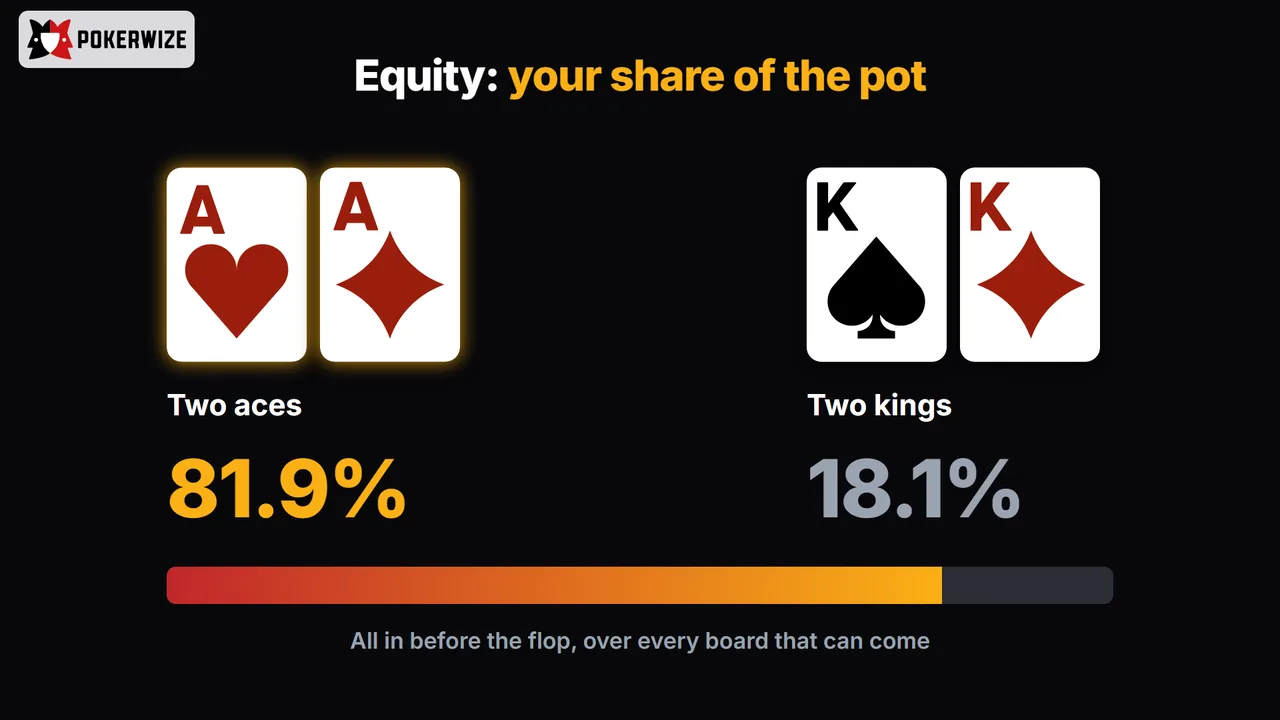
Count every way the rest of the board can come and take the share you win, with a tie counting as half. Before the flop, the ace of hearts and the ace of diamonds against the king of spades and the king of diamonds have 81.9% equity: over and over, they would take 81.9% of the pot.
Your share of the pot
Equity turns your chance of winning into chips. If 200 chips are in the middle and your equity is 81.9%, the pot is worth about 164 chips to you on average. You win all 200 some of the time and nothing the rest, and it averages out at your share.
Equity assumes every card gets dealt and nobody folds. That is exactly true when you are all in, and only a starting point when more betting is to come.
All in before the flop
Every pair of hands has an exact answer, worked out over all 1,712,304 boards that can come. Two examples:
| Hands | Equity |
|---|---|
| The ace of hearts and the ace of diamonds against the king of spades and the king of diamonds | 81.9% against 18.1% |
| The ace of clubs and the king of clubs against the queen of spades and the queen of hearts | 46.2% against 53.8% |
A big pair against a smaller pair is a big favorite. A pair against two higher cards is close to a coin flip, with the pair just ahead.
A worked hand
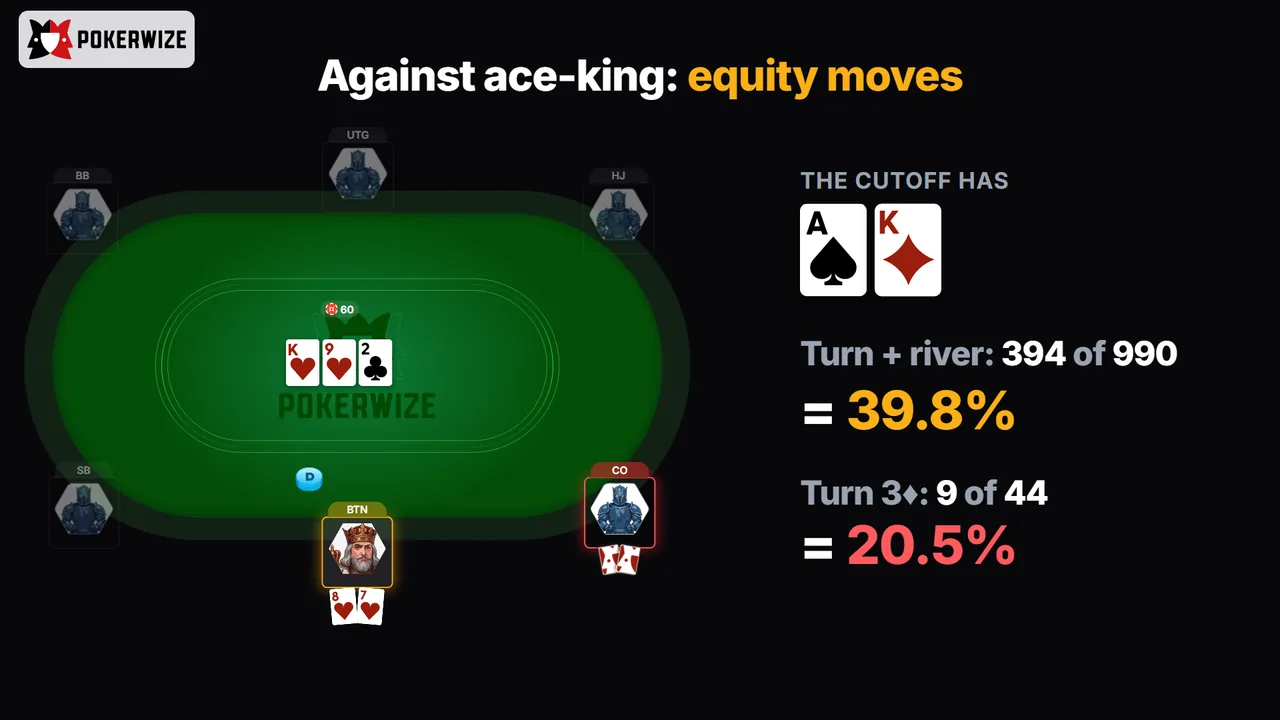
The cutoff raises and you call on the button with eight-seven of hearts. The blinds fold. The flop comes the king of hearts, the nine of hearts and the two of clubs, and there are 60 chips in the pot. Say the cutoff has the ace of spades and the king of diamonds: top pair.
With two cards to come, the turn and river can fall 990 ways. You win 394 of them, mostly with a heart, and a few with two cards like an eight and a seven, or a ten and a jack. That is 39.8% equity.
Now the turn comes the three of diamonds, which helps nobody. One card is left, so the river can come 44 ways, and only the 9 hearts win: 20.5%. Your equity roughly halved without a single chip going in.
That is why pot odds compare the price with the next card when more bets are coming: the 39.8% only belongs to you if you see both cards without paying again.
Common mistakes
- Treating equity as what you will win. You only collect your share if the hand reaches a showdown. Folding gives it up, and a bet that makes you fold takes it away: that is your opponent’s fold equity.
- Counting a tie as a win. A tie splits the pot, so it counts as half a win.
- Working it out against one hand. At the table you don’t see their cards, so your real equity is the average against every hand they could have: their range.
- Thinking it stays put. Equity moves with every card. In the worked hand, one blank turn took the draw from 39.8% to 20.5%.
In PokerWize
The PokerWize GTO Trainer shows your equity, your EV and the pot odds live on each decision, so you can watch your share of the pot change card by card. The Trainer is in the free plan. For equity, pot odds and implied odds on one hand, watch Episode 3.
Key takeaways
- Equity = your share of the pot if every card were dealt now, a tie counting as half.
- Aces against kings before the flop: 81.9%. A pair against two higher cards: close to a coin flip.
- Equity changes on every card, and you only collect it at a showdown.
Related terms
Watch it explained
Learn. Play. Master.
Put it into practice: start training for free at www.pokerwize.com.