How do you read a flop like a pro?
Don’t ask “did I hit it?” Ask who the flop helps across every hand each player could hold. Range advantage (which range does better on this board) tells you how often to bet. Nut advantage (who holds more of the very best hands) tells you how big.
Episode 4 of the Pro Mindset series, written out for people who’d rather read than watch. The poker numbers come from GTO solves, computer programs that play poker against themselves until they find an optimal strategy. It builds on Episode 3.
Remember Episode 3
In Episode 3 we learned to find the numbers ourselves: the price of a call, our equity, and the chips we can still win later. We found something odd on the flop: our call was priced right at the edge, and GTO still called happily. That’s because the flop isn’t really about the price. It’s about who the board helps.
Amateur vs pro
“I missed the flop, so I’m done.” “I raised before the flop, so I have to bet.” That’s the amateur talking, and the amateur asks one question: did I hit it? The pro asks a bigger one: who did this flop hit, me or them, across every hand we could both have?
The hand, from both chairs
Back to our hand. Under the gun raises, the hijack and the cutoff fold, and you call on the button with king-queen of hearts. The flop comes the ace of hearts, the nine of hearts and the three of spades. From your chair you missed: no pair, just king high and a flush draw. Under the gun is thinking, “There’s an ace, I raised, I should bet.” Both thoughts are about one hand, and neither of you knows the other’s cards. The only fair way to judge this flop is against everything each of you could be holding.
Range advantage
Think of a tug of war. Nobody asks whether one person on the rope is strong; you ask which team pulls harder overall. Each player brings a whole team of hands, their range, and the flop decides which team it helps. The range with more equity on that flop, more of the pot if every hand were played out, has the range advantage.
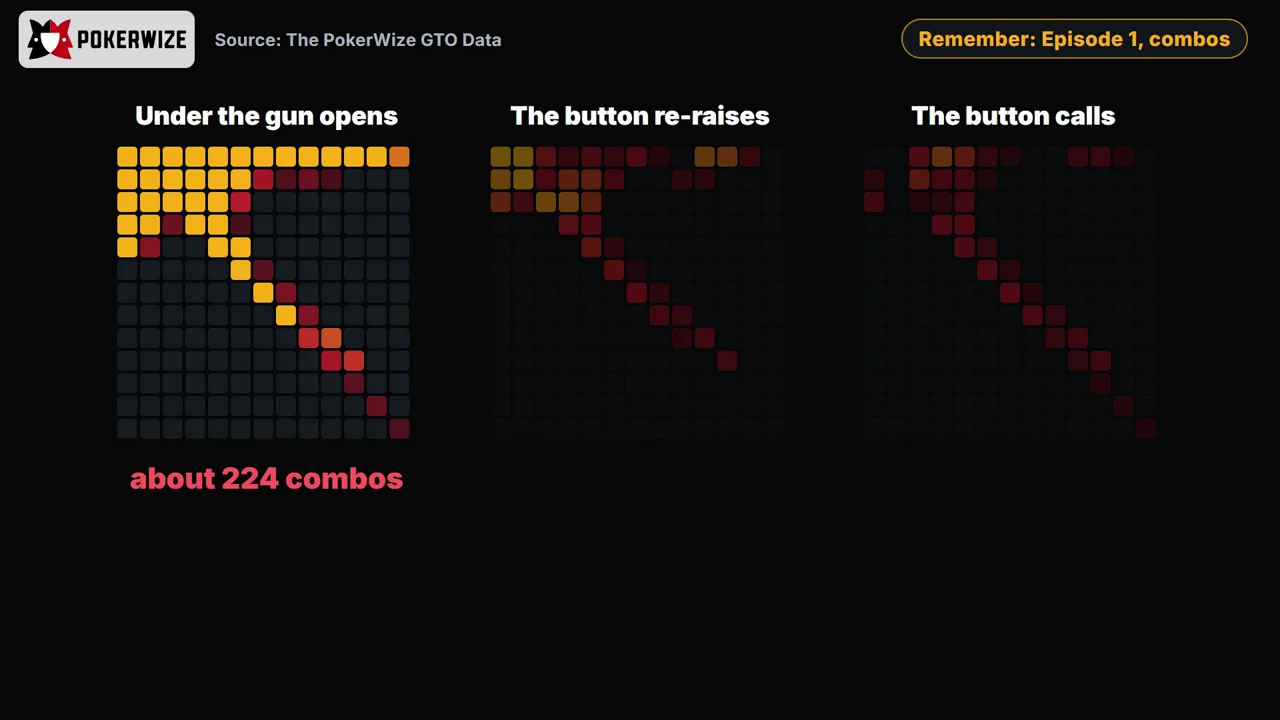
What do the two teams look like? From Episode 1, under the gun opens about 224 combos. The button, facing that raise, re-raises its very best hands, about 96 combos, and just calls with about 46. So when the button calls, its team is smaller and missing most of the strongest hands, because it would have re-raised them.
Three flops, three answers
Take a king-queen-jack flop, all different suits. Under the gun opened from the earliest seat, so their range is full of big cards: ace-king, king-queen and the big pairs. Put every hand they open against every hand the button calls with, deal out every turn and river, and under the gun wins about 57% of the pot, the button about 43%. A big range advantage for the raiser.
Same players, same ranges, now a seven of spades, six of hearts and five of spades. Under the gun’s big cards missed: about 70% of their range doesn’t even have a pair, while the button calls with more small pairs and makes three of a kind about twice as often. Now the button wins about 54%. Same hands before the flop, and the advantage flipped.
And our flop, ace of hearts, nine of hearts, three of spades? Under the gun opens every ace-king and plenty of other aces, so they win about 53% and the button about 47%. A range advantage, but a small one. And you only see it by looking at both ranges, not from your own two cards.
Nut advantage
Range advantage tells you who’s ahead overall. The second question is who has more of the very best hands: the nuts. On our flop, the best hands are three of a kind and two pair. About 6% of under the gun’s range has one, and about 5% of the button’s: close to even. The one hand only under the gun can have is three aces, because the button re-raises pocket aces every time before the flop, so when it just calls it never has them. Where under the gun pulls ahead is top pair: about 34% of their range has a pair of aces, against about 26% of the button’s. More good hands, but not many more great ones. Keep that in mind: it decides how big they should bet.
Dry and wet boards
A board like the ace of diamonds, seven of clubs and two of spades is dry: no flush draws and almost nothing to draw to, so the hand that’s ahead now usually stays ahead. A wet board has draws, so the next card can change who’s winning. Ours is in between: the cards are spread apart, but two hearts make flush draws live. Mostly the button holds them: about 8% of the button’s range has a flush draw and only about 4% of under the gun’s. Our king-queen of hearts is one of them.
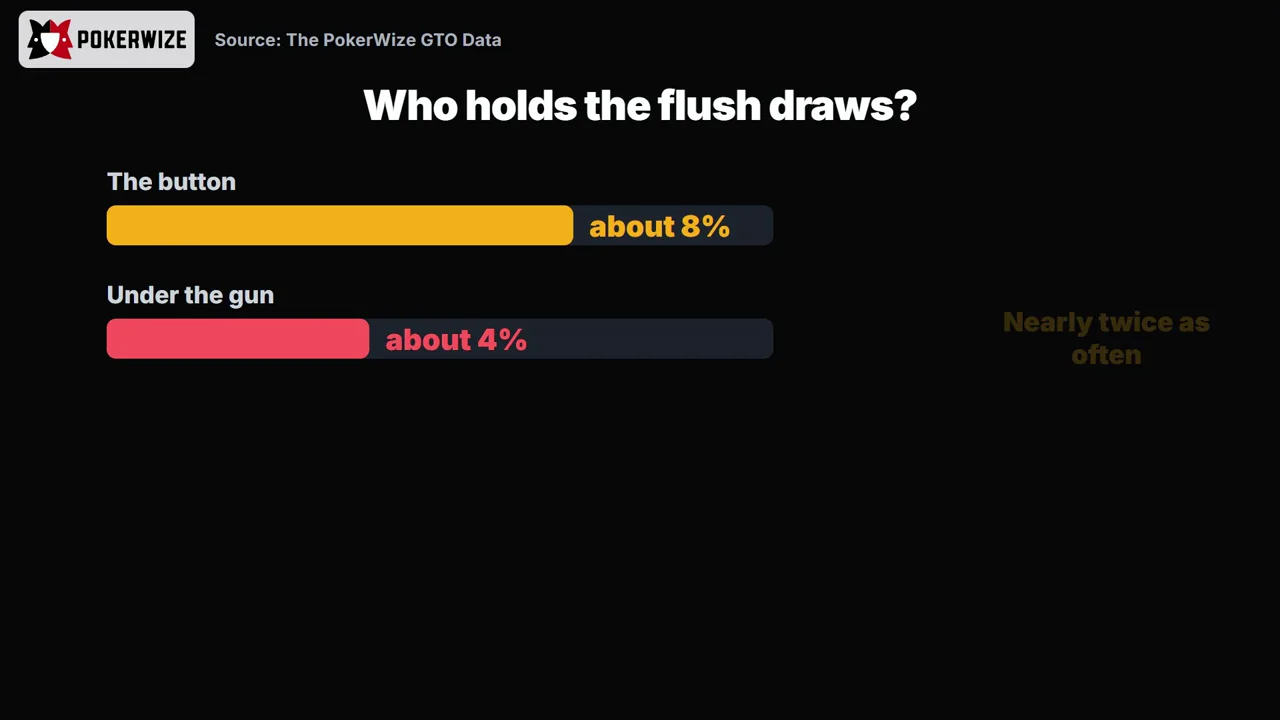
How much does that matter? The dry ace-seven-deuce gives under the gun the same 53% as our flop. The hearts don’t change who’s ahead today. They change what can happen on the turn.
You missed, but your hand didn’t
Against everything under the gun opens, king-queen of hearts has about 54% equity: a small favorite with king high. Against the hands under the gun bets with, you have about 49%. You missed, but your hand didn’t. With a price of 20%, folding never comes up, and GTO never folds this hand here. It calls about 7 times in 10 and raises the rest, and the call is worth about +6 big blinds.
Betting the flop: the c-bet
When the player who raised before the flop bets again on the flop, that’s a continuation bet, or c-bet. The rule the best players use: your range advantage tells you how often to bet, and your nut advantage tells you how big. A big edge across the range means you can bet a lot of hands; more of the very best hands means you can bet big.
Our flop gives under the gun a small range advantage and close to no nut advantage, so the answer is small bets, and not with every hand. That’s exactly what GTO does: with its whole range, under the gun bets only about a quarter of the time, and almost always a third of the pot. Even ace-king, top pair with the best kicker, bets only about half the time. If ace-king doesn’t bet every time, “I raised so I have to bet” isn’t a plan.
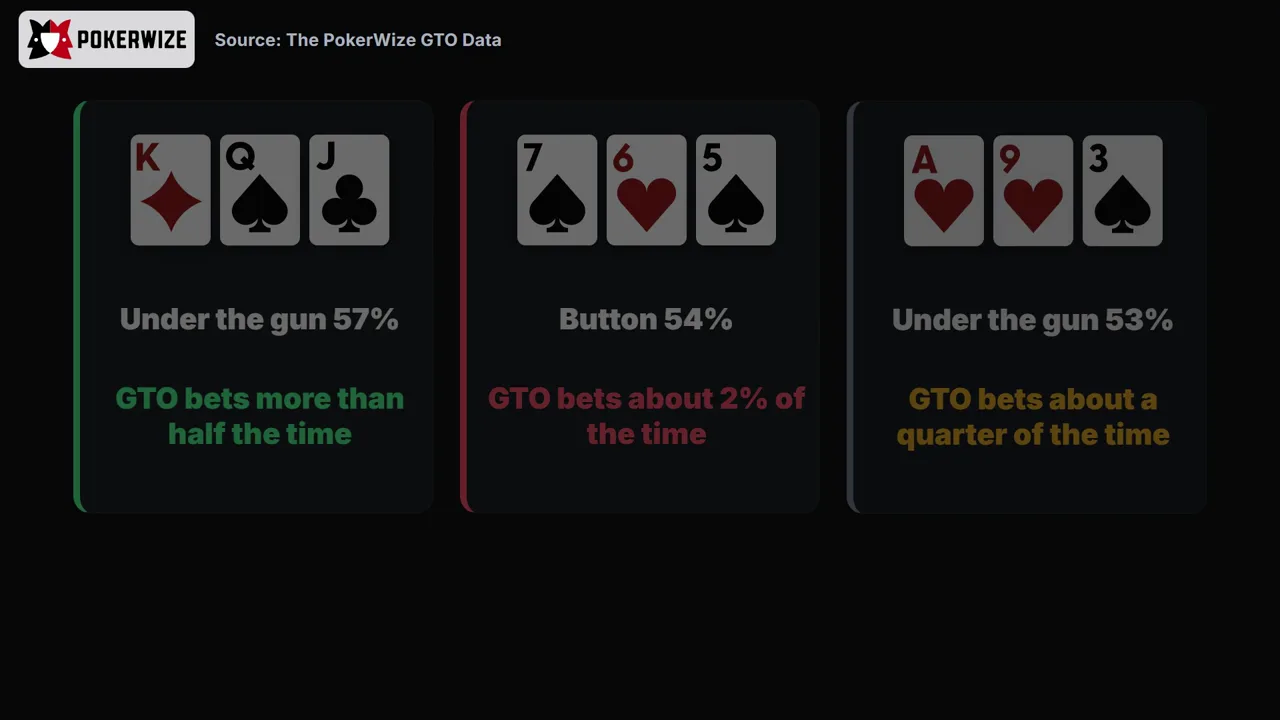
Look at the other two flops. On king-queen-jack, where under the gun wins about 57%, GTO bets more than half the time, over twice as often as on our flop. On seven-six-five, where the button wins about 54%, under the gun checks almost everything and bets about 2% of the time. The right play depends on the board.
Three questions at the table
Next time the flop comes down, before you think about your own two cards, ask three questions. Who does this flop help more, my range or theirs? Who has more of the very best hands? And how much can the next card change? Then look at your hand and decide where it fits.
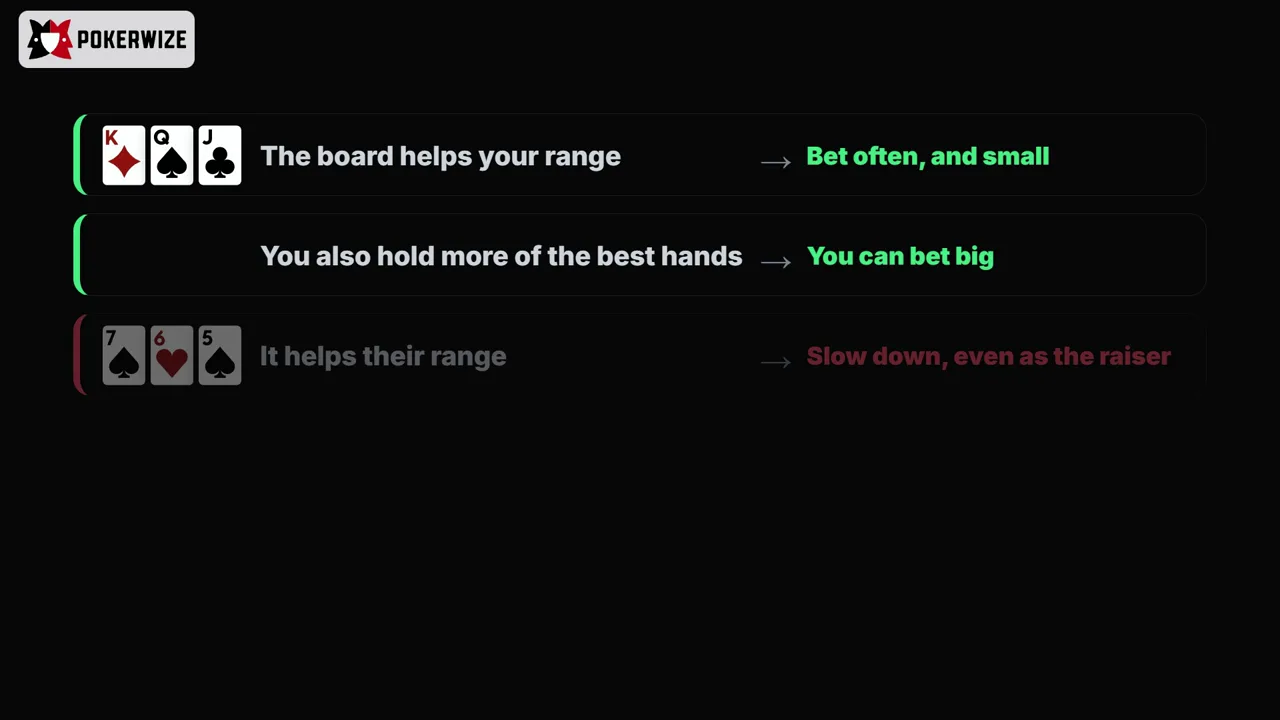
If the board helps your range, bet often, and small. If you also hold more of the very best hands, you can bet big. If it helps their range, slow down, even when you raised before the flop. You’re not playing your hand against the board. You’re playing your range against theirs. The PokerWize GTO Trainer shows your EV, equity and pot odds live as you practice.
Key takeaways
- Judge a flop against both ranges: who has more equity (range advantage) and who has more of the best hands (nut advantage).
- The same ranges can flip on a new board: king-queen-jack favors the raiser (about 57%), seven-six-five the caller (about 54%).
- Range advantage sets how often to bet, nut advantage how big. On our ace-nine-three flop GTO bets about a quarter of the time, almost always a third of the pot.
- You missed the flop, but your hand may not have: king-queen of hearts has about 54% equity against under the gun’s whole range.
Learn. Play. Master.
Put it into practice: start training for free at www.pokerwize.com.