How do you work out fold equity?
For a bet that never wins when called, divide your bet by your bet plus the pot: that is how often they must fold for it to break even. A bluff of half the pot needs a fold 33.3% of the time. When your hand can still win if called, it needs fewer folds.
Winning without a showdown
Every bet can win two ways: they fold now, or you have the best hand at the end. Fold equity is the first part. A pure bluff lives on it alone. A semi-bluff, a bet with a draw, gets both.
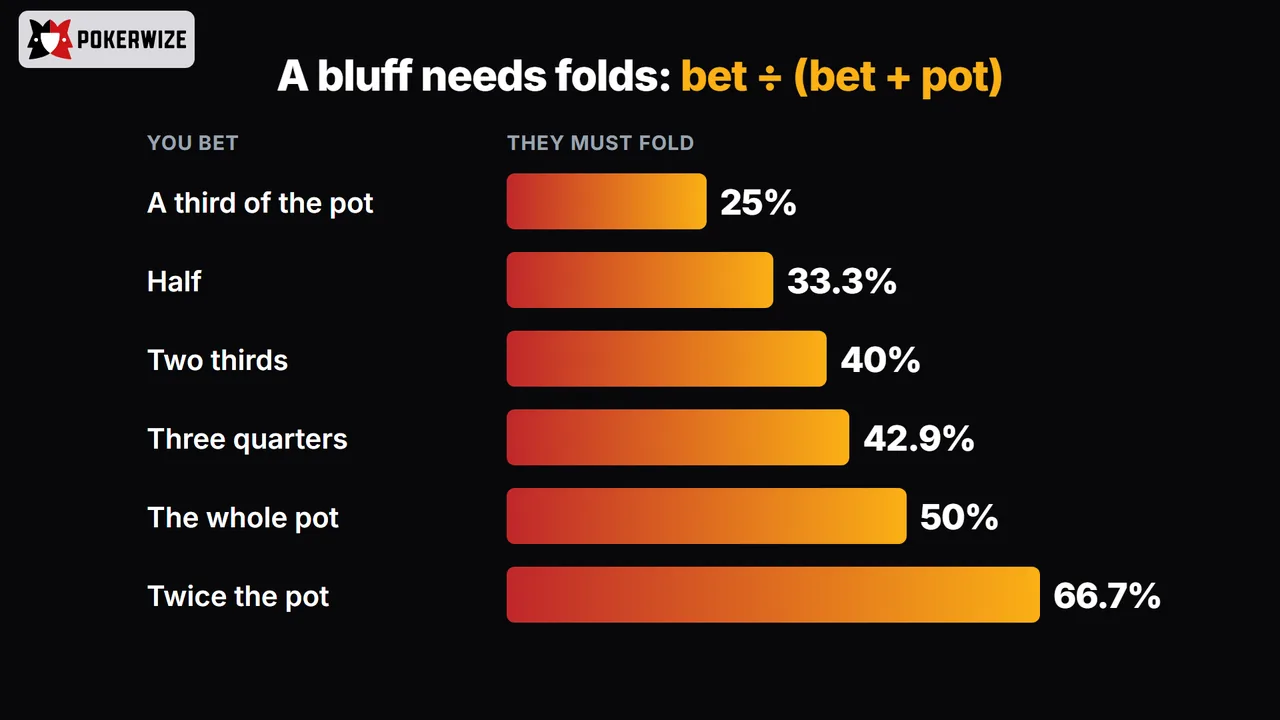
How often a bluff needs a fold
A bigger bluff risks more to win the same pot, so it needs more folds. These hold at any stakes, because they only depend on the bet’s size compared with the pot.
| You bet | They must fold |
|---|---|
| A third of the pot | 25% |
| Half the pot | 33.3% |
| Two thirds of the pot | 40% |
| Three quarters of the pot | 42.9% |
| The whole pot | 50% |
| Twice the pot | 66.7% |
A worked hand: the semi-bluff
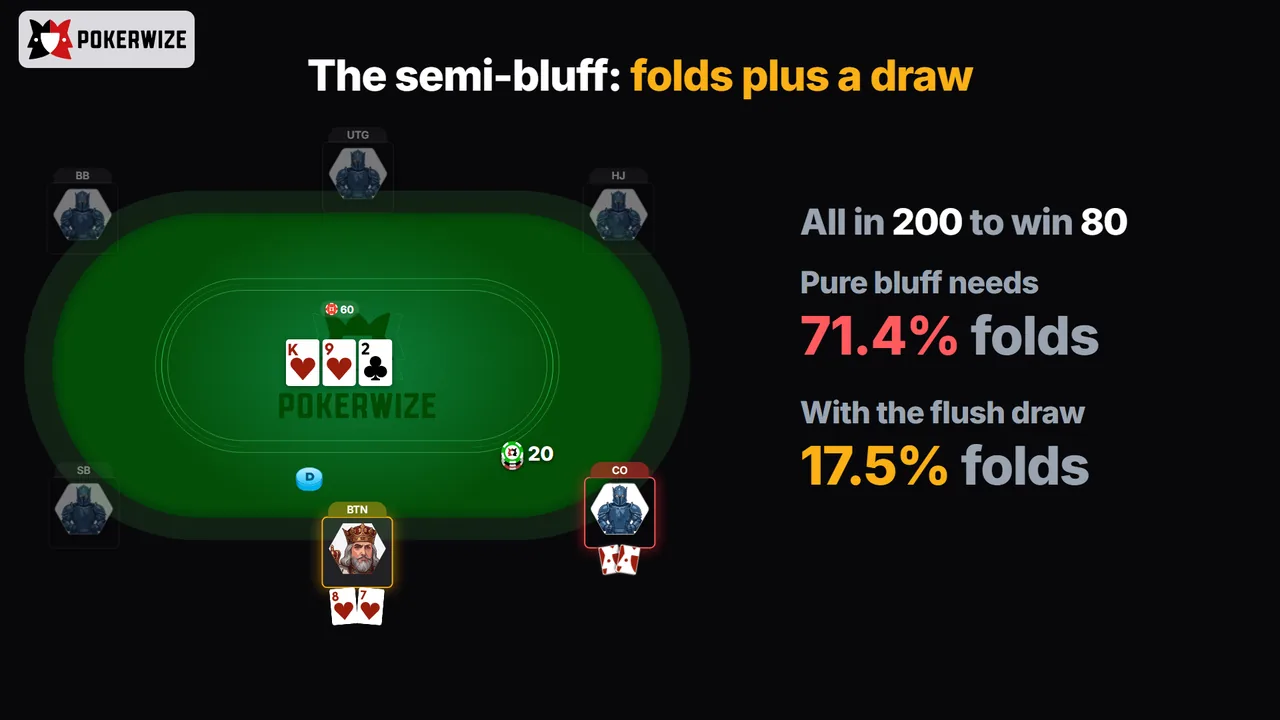
The cutoff raises and you call on the button with eight-seven of hearts. The blinds fold. The flop comes the king of hearts, the nine of hearts and the two of clubs, and there are 60 chips in the pot. You both have 200 chips left. The cutoff bets 20 and you move all in for 200.
If the cutoff folds, you win the 80 in the middle. As a pure bluff, risking 200 to win 80 would need a fold 71.4% of the time.
But you have a flush draw. Say the cutoff calls with the ace of spades and the king of diamonds. The pot is then 460, and with both cards to come you win it 394 times in 990, 39.8% of the time: on average you get back about 183.1 of your 200. Being called costs you about 16.9 chips, not 200.
So the all-in breaks even when the cutoff folds just 17.5% of the time: each fold wins 80, each call loses about 16.9. The draw cuts the folds you need from 71.4% to 17.5%.
One catch: with ace-king, the cutoff shouldn’t fold. They call 180 to win 280, a price of 39.1%, and they win 60.2% of the time. Your folds come from the weaker hands in their range, so fold equity is always about their whole range, not one hand.
Common mistakes
- Bluffing a player who doesn’t fold. Fold equity needs someone who folds. Against a calling station, bet your good hands instead.
- Forgetting your equity when called. A draw that wins 39.8% when called needs far fewer folds than a bluff that never wins.
- Counting on one hand to fold. Whether they fold depends on what they hold, so count your folds against everything they could have.
In PokerWize
The PokerWize GTO Trainer shows your EV, your equity and the pot odds live on each decision, so you can check these sums against real spots as you play. The Trainer is in the free plan. For fold equity on a real hand, watch Episode 3.
Key takeaways
- A pure bluff needs folds: your bet ÷ (your bet + the pot). Half the pot needs 33.3%.
- A semi-bluff also wins when called, so it needs far fewer folds: 17.5% instead of 71.4% in the worked hand.
- Fold equity depends on what they hold: count it against their whole range.
Related terms
Watch it explained
Learn. Play. Master.
Put it into practice: start training for free at www.pokerwize.com.