How do you work out expected value?
Take each way the decision can turn out, multiply what you win or lose by how often it happens, and add them up. Calling 20 to win 80 with a flush draw that hits 9 times in 47 is (9 × 80 − 38 × 20) ÷ 47: a loss of about 0.9 chips a call. Folding is worth zero.
A decision, not a result
Any single hand is partly luck: a good call can lose and a bad one can win. EV is what the decision earns on average, over and over, so it tells you whether a play was good however this one hand ends.
It is measured from the moment you decide. Chips you put in earlier don’t count, because they are already in the pot whatever you do next.
A worked hand
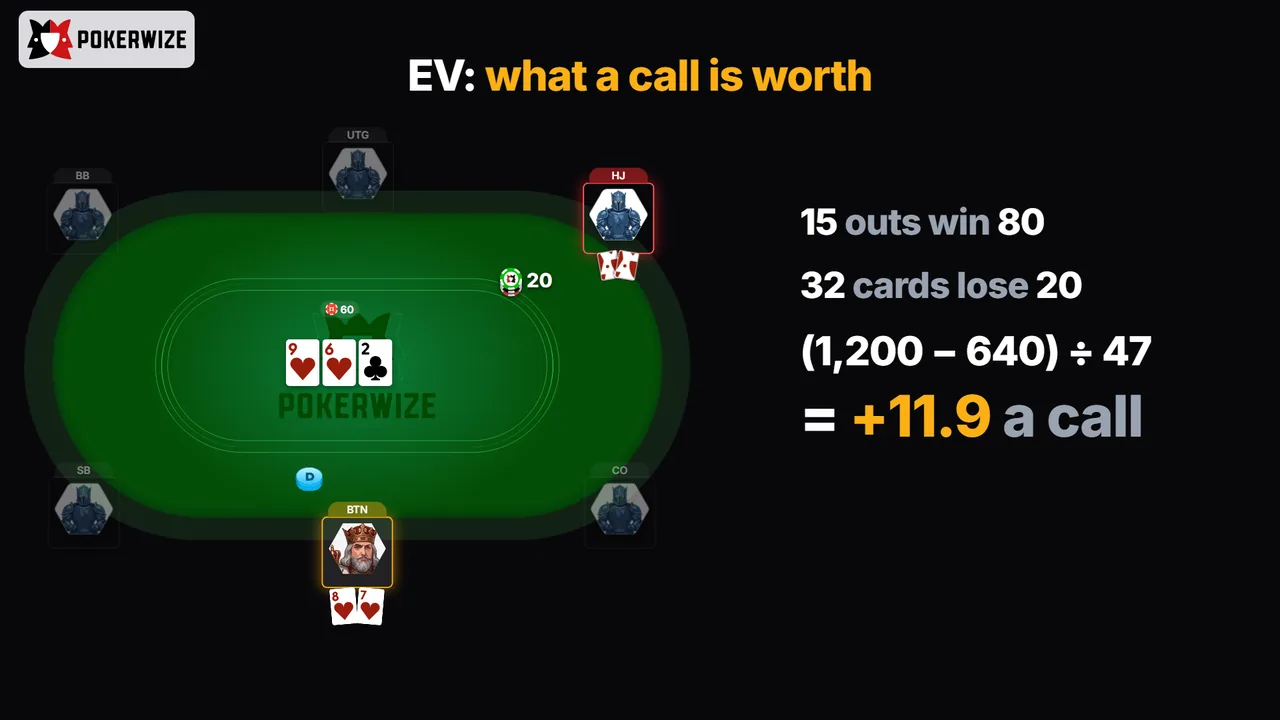
The hijack raises, the cutoff folds and you call on the button with eight-seven of hearts. The blinds fold. The flop comes the nine of hearts, the six of hearts and the two of clubs, and there are 60 chips in the pot. The hijack bets 20.
You have a flush draw and a straight draw: 15 outs. Count the turn only, and say every out wins and every other card loses. Out of 47 turn cards, 15 win you the 80 in the middle and 32 lose your 20. Over 47 calls you win 1,200 and lose 640, up 560: an EV of about 11.9 chips a call.
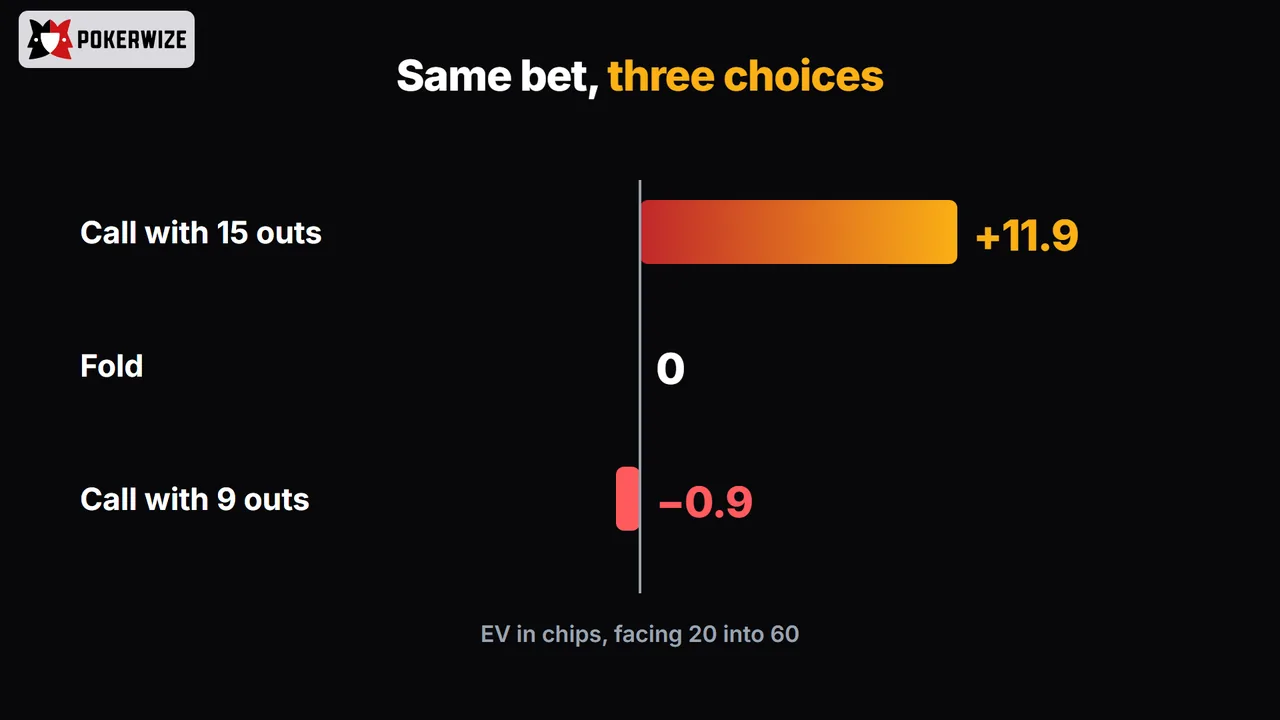
Now the flush draw alone, from the pot odds hand: eight-seven of hearts on the king of hearts, the nine of hearts and the two of clubs, 9 outs instead of 15. Over 47 calls you win 720 and lose 760, so the call loses about 0.9 chips. Folding is worth 0, so the fold is better by a hair, unless implied odds make up the gap.
| Facing 20 into 60 | EV of each choice |
|---|---|
| Call with the flush draw and straight draw | +11.9 chips |
| Fold | 0 chips |
| Call with the flush draw alone | −0.9 chips |
Common mistakes
- Judging a play by how it ended. A call worth +11.9 chips that misses is still a good call: decisions first, results last.
- Counting chips already in the pot as yours. They stopped being yours when you put them in. Folding loses nothing from here.
- Stopping at one card. These sums leave out the river and later bets. Implied odds and fold equity add the rest.
In PokerWize
The PokerWize GTO Trainer shows your EV live on each decision and grades each one by how much EV it gives up against the solver’s play. The Trainer is in the free plan. For EV on real hands, watch Episode 2, and for judging decisions over results, Episode 8.
Key takeaways
- EV = chance you win × what you win − chance you lose × what you lose. Folding is worth 0.
- With 15 outs facing 20 into 60, the call is worth about +11.9 chips; with 9 outs, about −0.9.
- Judge a play by its EV, not by how one hand ended.
Related terms
Watch it explained
Learn. Play. Master.
Put it into practice: start training for free at www.pokerwize.com.