How do you know when to call with a draw?
Price it. Pot odds tell you how often a call has to win to break even: what you risk divided by what you risk plus what you can win. Count your outs to see how often you actually win. If your equity beats the price, call. If it doesn’t, ask whether what you can win later covers the gap.
Episode 3 of the Pro Mindset series, written out for people who’d rather read than watch. The poker numbers come from GTO solves, computer programs that play poker against themselves until they find an optimal strategy; the rest is simple arithmetic. It continues Episode 2.
Remember the EV recipe
In Episode 2 we learned one recipe for what any decision is worth: the chance you win times what you win, minus the chance you lose times what you lose. We ran it on a coin flip, on aces against kings, and on our own turn raise, which lost about a big blind every time. But every time, someone handed us the chances. At the table, nobody does. Today you learn to find them yourself.
The hand, and the hope
Same hand. Under the gun raises, the hijack and the cutoff fold, and you call on the button with king-queen of hearts. The flop comes the ace of hearts, the nine of hearts and the three of spades. Under the gun bets a third of the pot and you call. The turn is the five of clubs and they bet more than the whole pot. And here’s the thought almost everyone has: “I’ve got a flush draw, I’ve come this far, I have to see the river.” It feels like a plan, but it’s really just a hope. By the end you’ll know exactly where Episode 2’s numbers came from.
Amateur vs pro
The amateur asks, “Do I think I’m ahead?” The pro asks, “How often do I win, and what does it cost me?” The amateur says, “The pot’s huge, I can’t fold now.” The pro knows the chips in the middle aren’t theirs anymore. Only the next decision is.
The price: pot odds
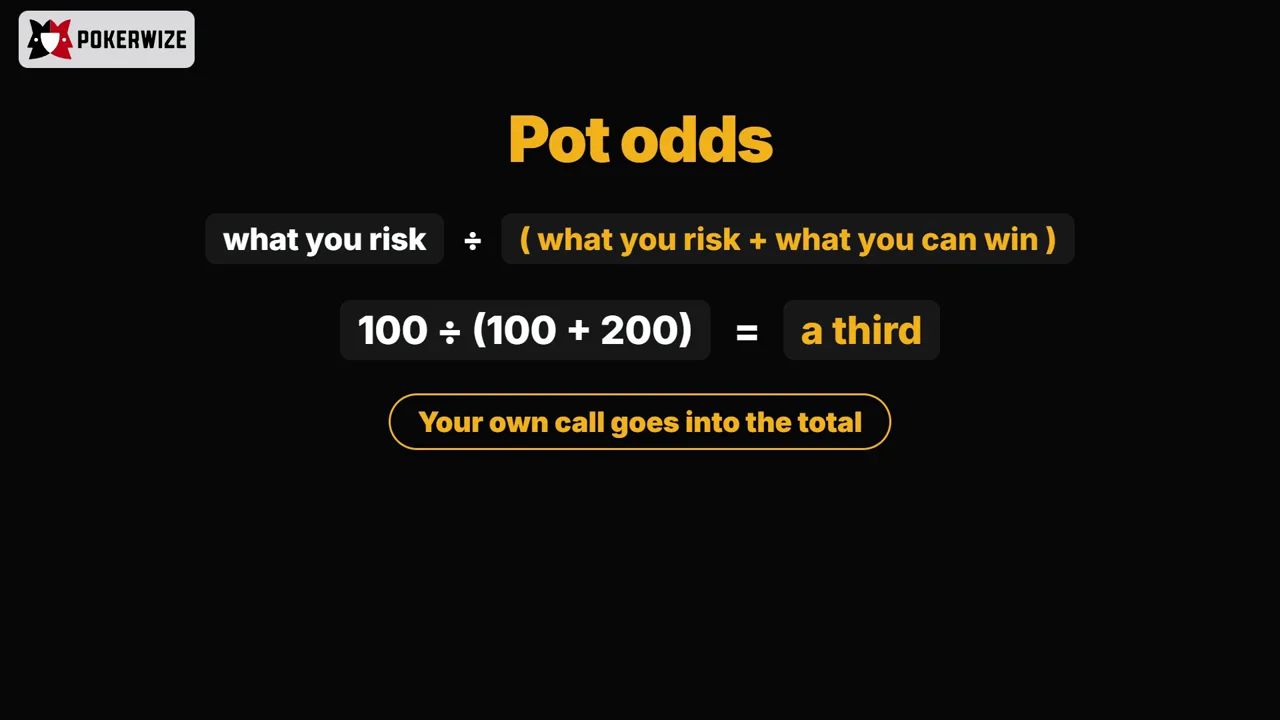
Take the recipe and ask a simpler question: how often does a call have to win just to break even? Say the pot is 100 chips and they bet 100. You put in 100, and if you win you take the 200 that’s out there, so you win 200 and lose 100. For the two sides to cancel, you need to win one time for every two you lose: a third of the time. That break-even number is pot odds, one simple sum: what you risk, divided by what you risk plus what you can win. Here, 100 out of 300, a third. Your own call goes into that total; leaving it out is one of the most common slips. (It’s the insurance bet from Episode 2: paid 2 to 1, so it has to win a third of the time.)
Same hand, different price
The smaller the bet, the cheaper the call. Against a third of the pot you only need to win 20% of the time; the bigger they bet, the more often you need to win. On our flop, under the gun bet a third of the pot, so the price was 20%. On the turn they bet one and a quarter times the pot, about 15.6 big blinds. The pot now holds about 28, so you risk 15.6 to win 28: 15.6 out of about 43.6, or about 36%. Same cards, same draw, and the price nearly doubled.
Counting your outs
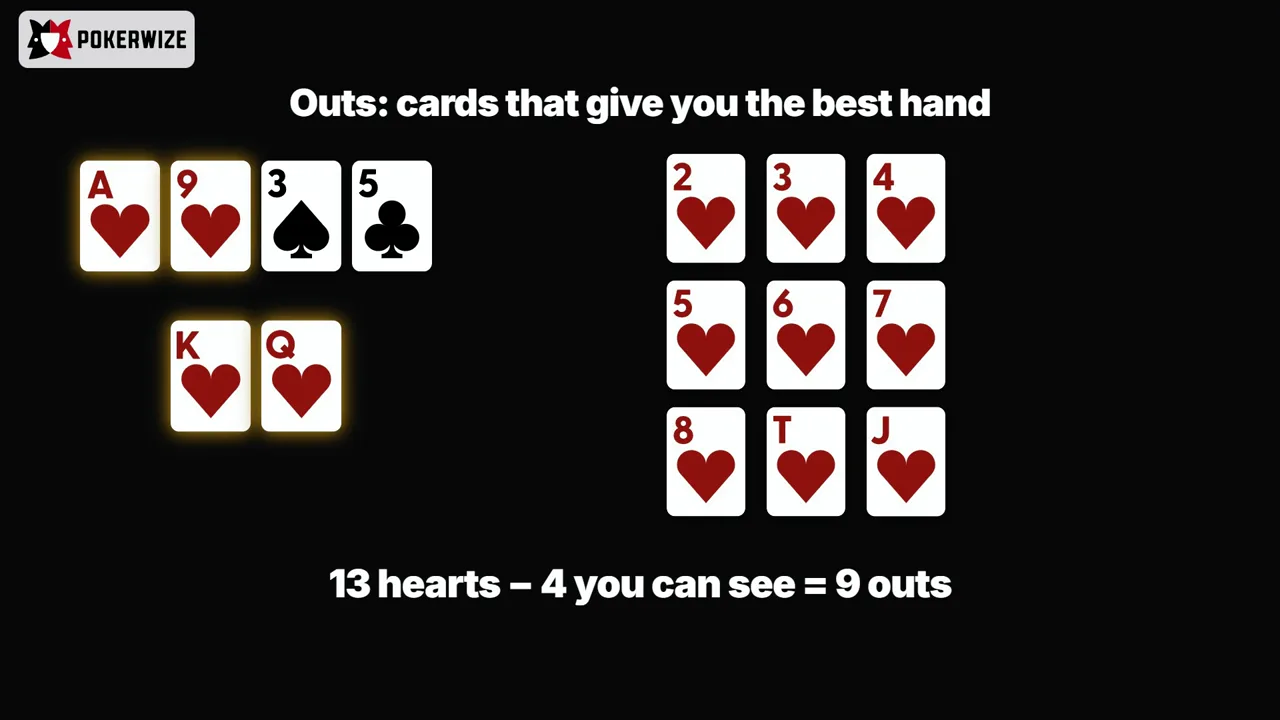
How often do you actually win? Start with your outs: cards still in the deck that give you what’s most likely the best hand. You have four hearts, two in your hand and two on the board. There are 13 hearts in the deck, so 13 minus 4 leaves 9 that can still come: 9 outs. And since the ace of hearts is on the board, any heart gives you the best possible flush. An open-ended straight draw has 8 outs and a gutshot just 4.
The Rule of 2 and 4, and equity
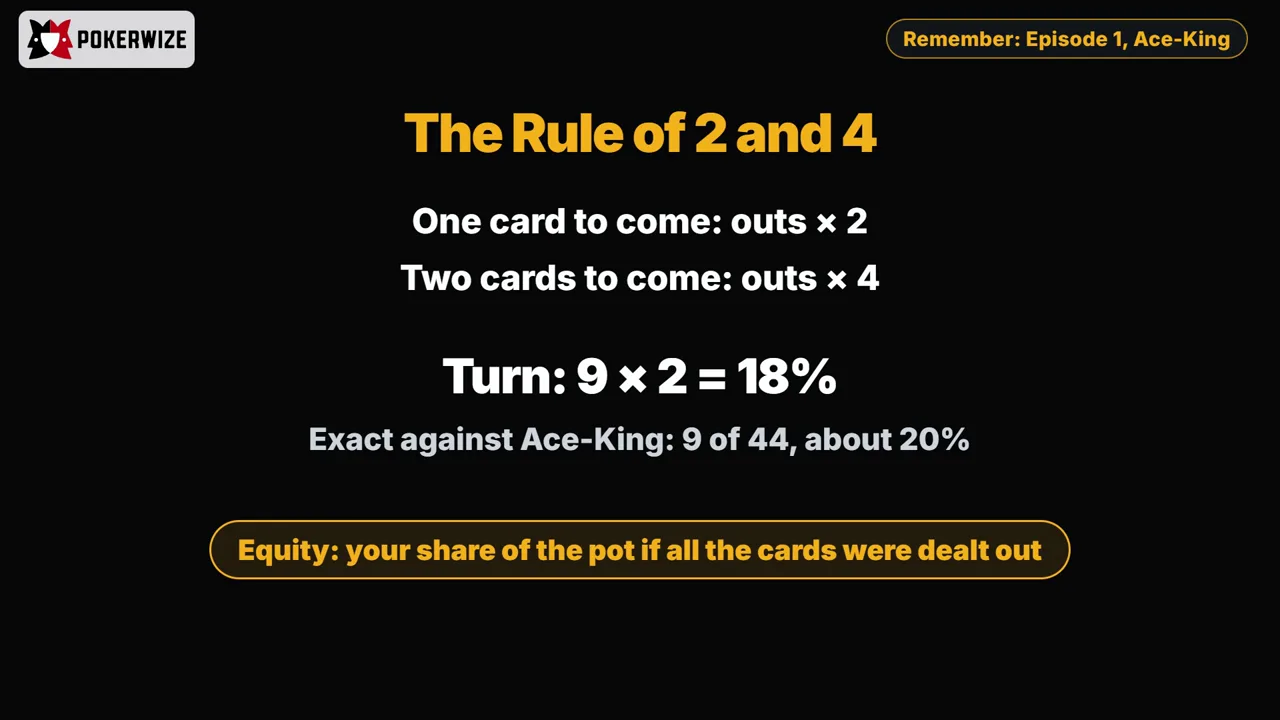
To turn outs into a percentage, use the Rule of 2 and 4. With one card to come, multiply your outs by 2. With two cards to come, multiply by 4. On the turn there’s one card left, so 9 × 2 is 18%. Against ace-king, the exact answer is 9 of the 44 cards left, about 20%. That number has a name: equity, your share of the pot if all the cards were dealt out right now.
The catch in the Rule of 4
The Rule of 4 comes with a catch. On the flop, 9 × 4 is 36, and the exact number against ace-king is 37%. Against a price of 20% that looks like an easy call. But 36% is your chance by the river, and it assumes you see both cards for that one price. You don’t: under the gun bet again on the turn and you had to pay again. One card at a time, the flop gives you 9 of the 45 cards you can’t see, exactly 20%, right at the price. So the flop call isn’t really about the price. It’s about what you can win later.
The turn, run through the recipe
The five of clubs missed. Your equity against ace-king is about 20% and the price is 36%. About 20% of the time the heart comes and you win the 28 in the pot; the rest of the time you lose your 15.6. On the price alone, this call loses about 7 big blinds. But in Episode 2, GTO said this call is worth almost exactly zero. Where does the missing money come from? The river.
Implied odds: why the call is worth zero
Pot odds only count the chips in the middle right now. When your heart comes there’s still a street to play, and you can win more on it. Those future chips are implied odds. Against ace-king, the call breaks even if you win about 33 more big blinds on the river when the heart comes: a bet of about three quarters of the pot, and them calling it. With about 79 big blinds left behind, there’s room.
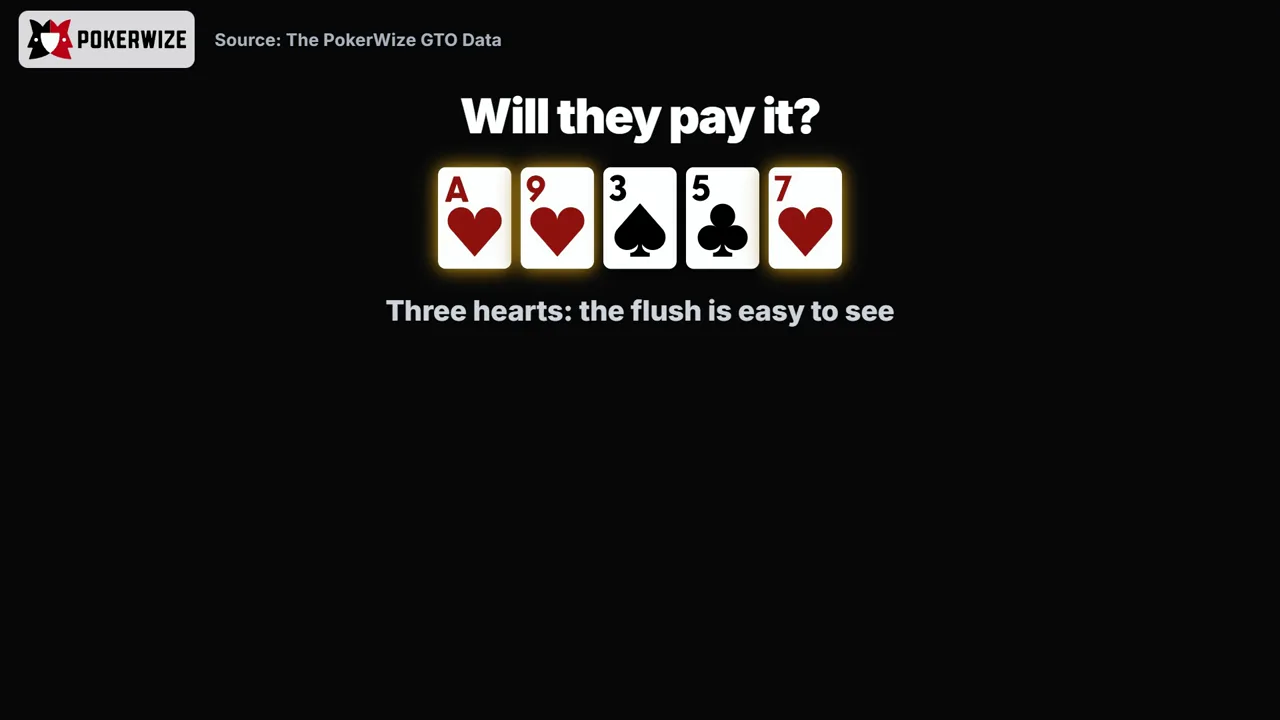
So the real question is whether they’ll pay it. Implied odds are a guess about the future, and players love to overestimate them. They shrink when the stacks are short and when your draw is obvious. Against everything under the gun bets this big with, your equity is about 27%, since not every hand they bet has you beaten. Put it all together and GTO’s answer is the one from Episode 2: the call is worth almost exactly zero.
The raise: semi-bluffs and fold equity
A raise with a draw is a semi-bluff, because it can win two ways: they fold and you take the pot now, or they call and you can still hit. The part that comes from them folding is fold equity, and you price it with the same math from the other chair. Your smallest raise is to about 37.4 big blinds. You risk 37.4 to win the 28 already in the middle: 37.4 out of about 65.4. As a pure bluff, that has to work 57% of the time. Under the gun folds about 49% of the time. Your equity makes up some of the gap but not all of it, which is why the raise still loses about a big blind.
So every number from Episode 2 is explained. Folding is zero. The call is short on the price, and the river pays it back to about zero. And the raise needs more folds than it gets. None of that was hope.
Four questions at the table
Next time you catch yourself thinking “I’ve come this far,” ask four questions. What’s my price? What you risk divided by what you risk plus what you can win. What’s my equity? Your outs times 2, or times 4, one card at a time when more bets are coming. What can I win later? Your implied odds, which depend on the player and the board. And will they fold? That’s your fold equity.
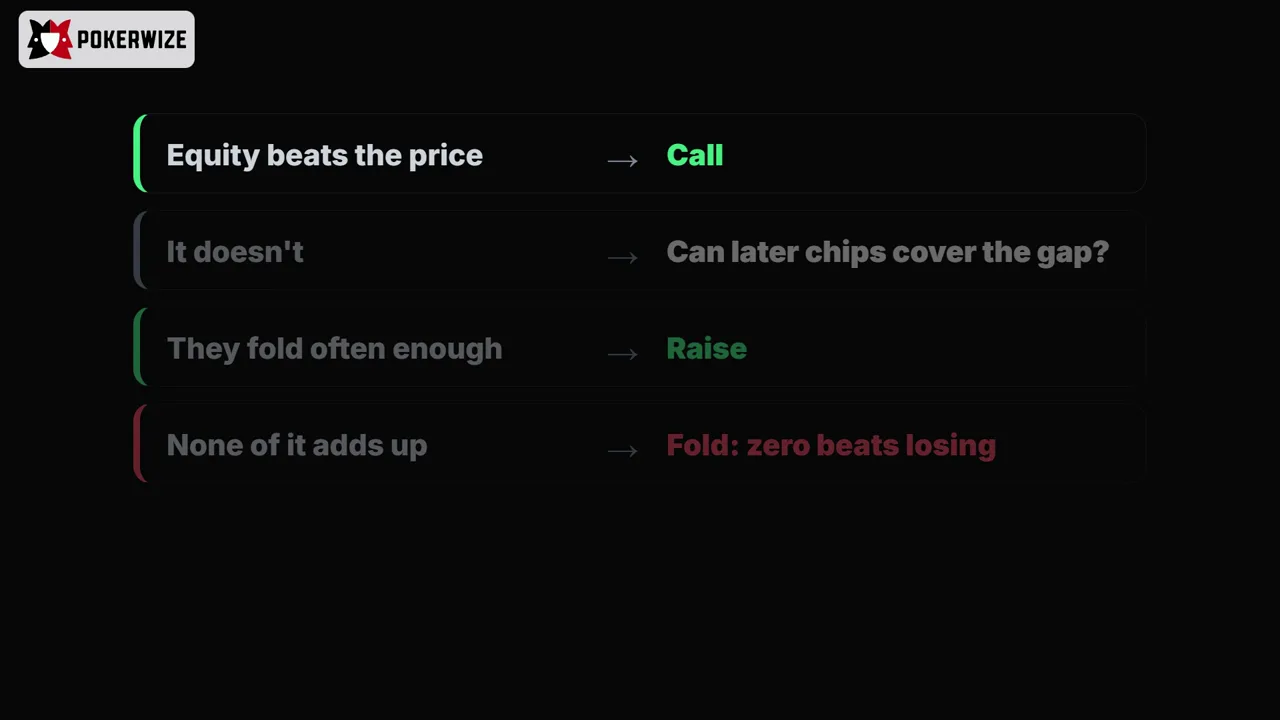
If your equity beats the price, call. If it doesn’t, ask whether what you can win later covers the gap. If they’ll fold often enough, raise. And if none of it adds up, fold, because folding is worth zero, and zero beats losing. That’s how a hope turns into a decision. To practice, the PokerWize GTO Trainer shows your EV, your equity and the pot odds live on each decision.
Key takeaways
- Pot odds = what you risk ÷ (what you risk + what you can win). Against a third-pot bet you need 20%; against 1.25× pot, about 36%.
- Count outs (13 hearts − 4 you can see = 9), then × 2 for one card or × 4 for two, one card at a time when more bets are coming.
- Implied odds are a guess about the future: about 33 more big blinds on the river made our call break even.
- A raise needs enough folds: ours had to work 57% of the time and got about 49%.
Learn. Play. Master.
Put it into practice: start training for free at www.pokerwize.com.