How do you count outs in poker?
Count the cards still unseen that would give you what’s most likely the best hand. With four hearts between your hand and the board, 13 hearts minus the 4 you can see leaves 9 outs. From the flop, 9 outs hit on the turn about 19.1% of the time, and by the river about 35%.
What an out is
An out is a card that turns your hand into a likely winner. Outs matter for draws: hands that aren’t made yet but can be. Count them and you know how often you’ll hit, which is half of every decision with a draw. The other half is the price, your pot odds.
Count only the cards you can’t see. From the flop that’s 47 cards: 52, minus your two, minus the three on the board. On the turn it’s 46.
Counting the common draws
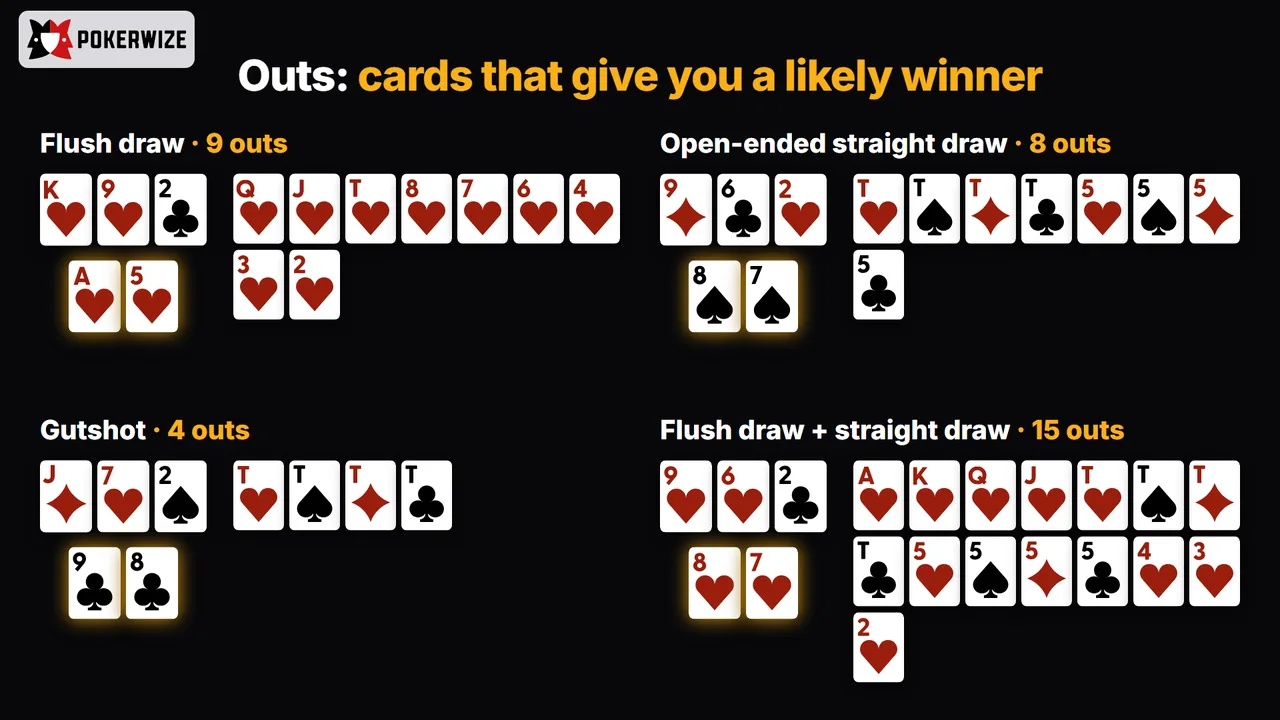
- Flush draw, 9 outs. Ace-five of hearts on a flop of the king of hearts, nine of hearts and two of clubs: 13 hearts, minus the 4 you can see.
- Open-ended straight draw, 8 outs. Eight-seven of spades on nine of diamonds, six of clubs, two of hearts: any ten or any five makes a straight, four of each.
- Gutshot, 4 outs. Nine-eight of clubs on jack of diamonds, seven of hearts, two of spades: only a ten fills the middle.
- Flush draw and straight draw, 15 outs. Eight-seven of hearts on nine of hearts, six of hearts, two of clubs: 9 hearts, plus the tens and fives that aren’t hearts, 3 of each. Not 17: the ten of hearts and five of hearts are already in the 9.
From outs to a percentage
From the flop, the chance of hitting on the very next card is your outs out of 47. The chance of hitting by the river counts both cards, which you only get to see for one price if nobody bets again. The Rule of 2 and 4 is the quick version: outs times 2 for one card, times 4 for two.
| Draw | Outs | Next card | By the river | Rule of 2 and 4 |
|---|---|---|---|---|
| Flush draw | 9 | 19.1% | 35% | 18% / 36% |
| Open-ended straight draw | 8 | 17% | 31.5% | 16% / 32% |
| Gutshot | 4 | 8.5% | 16.5% | 8% / 16% |
| Flush + straight draw | 15 | 31.9% | 54.1% | 30% / 60% |
On the turn there are 46 cards left, so 9 outs hit the river 9 times in 46, about 19.6%.
A worked hand
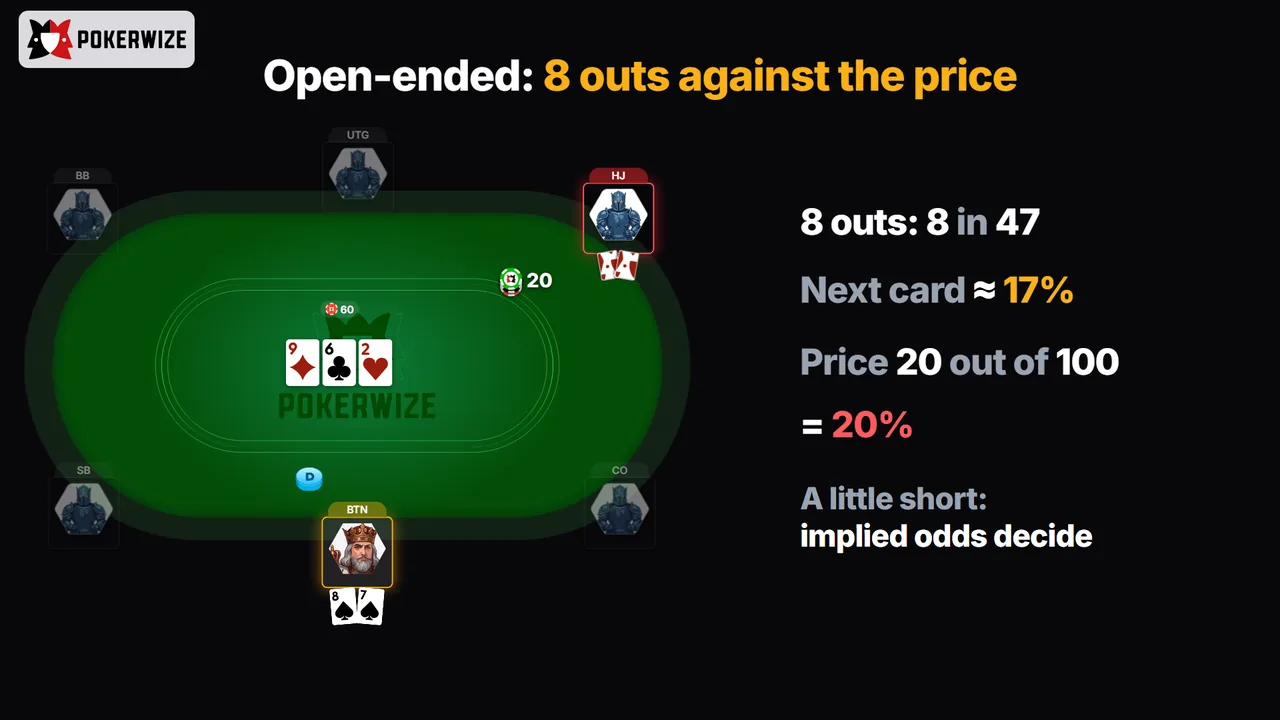
The hijack raises, the cutoff folds and you call on the button with eight-seven of spades. The blinds fold. The flop comes the nine of diamonds, the six of clubs and the two of hearts, and there are 60 chips in the pot. The hijack bets 20.
You have an open-ended straight draw: 8 outs, so the turn brings a straight 8 times in 47, about 17%. The price is 20 out of 100, 20%. On the next card alone you’re a little short, so the call needs a little more from later streets: your implied odds.
Common mistakes
- Counting an out twice. With a flush draw and a straight draw, the cards that make both count once: 15 outs, not 17.
- Counting outs that don’t win. An out is only as good as the hand it makes. If your opponent can hold a bigger flush draw, or the board is paired so a full house beats your flush, some of your outs lose. When your flush isn’t the best possible one, or the board is paired, count only the cards that make the best hand.
- Using the Rule of 4 when another bet is coming. 36% by the river assumes you see both cards for one price. If your opponent will bet again on the turn, compare one card at a time.
- Trusting the rule with big draws. The Rule of 4 overstates large draws: 15 outs is 54.1% by the river, not 60%.
In PokerWize
The PokerWize GTO Trainer shows your equity and the pot odds live on each decision, so you can check your count against the exact number as you play. The Trainer is in the free plan. To see outs and pot odds worked through on one hand, watch Episode 3.
Key takeaways
- Outs are unseen cards that give you a likely winner: 9 for a flush draw, 8 open-ended, 4 for a gutshot.
- From the flop: outs out of 47 for the next card; on the turn, out of 46.
- Count overlapping outs once, and take off outs that make a hand that can still lose.
Related terms
Watch it explained
Learn. Play. Master.
Put it into practice: start training for free at www.pokerwize.com.