How do you work out pot odds?
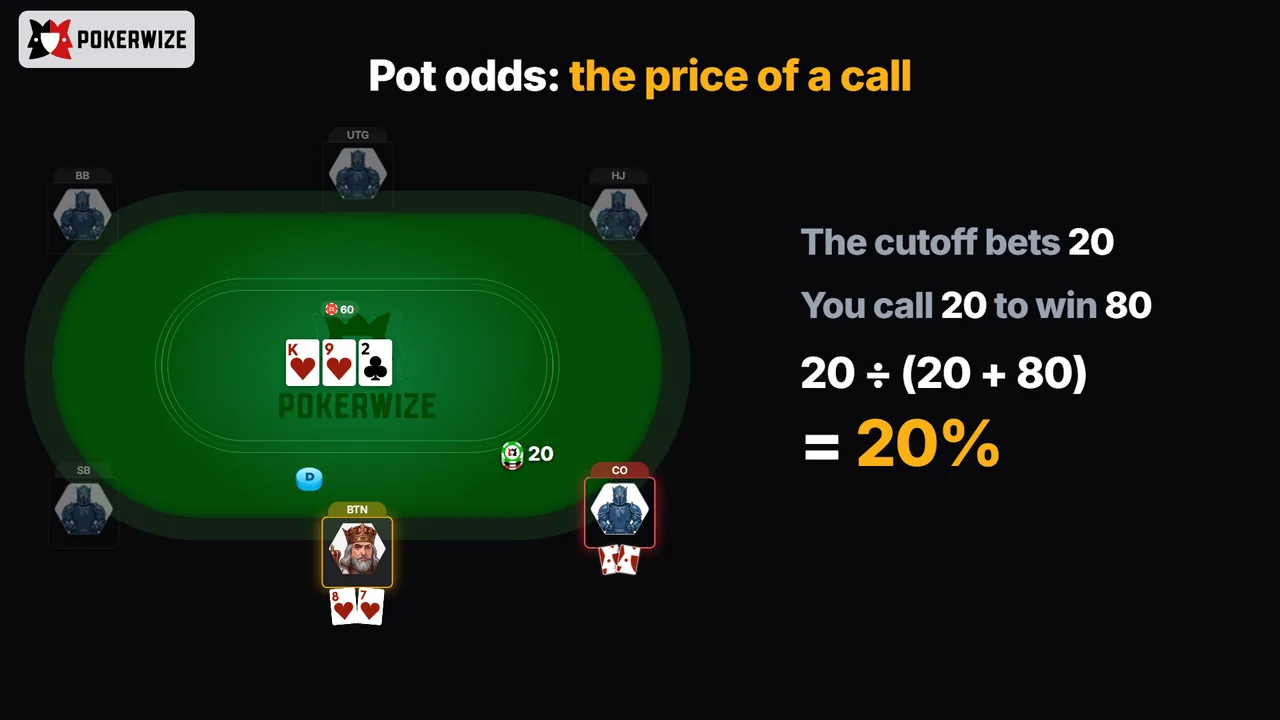
Divide what you have to call by the total pot after your call: what you risk, divided by what you risk plus what you can win. Facing a bet of a third of the pot, you call 20 to win 80, so you need to win 20 out of 100, or 20% of the time, to break even.
The price of a call
Every call has a price. Pot odds tell you that price as a share: how often the call has to win so that, over many tries, you get back exactly what you put in. If you win more often than that, the call makes money. If you win less often, it loses money, however big the pot looks.
The sum has one trap. The pot you can win includes your opponent’s bet, and the total includes your own call. Leave your call out and every price looks dearer than it is, so you fold calls that make money.
A worked hand
The cutoff raises and you call on the button with eight-seven of hearts. The blinds fold. The flop comes the king of hearts, the nine of hearts and the two of clubs, and there are 60 chips in the pot. You have a flush draw.
The cutoff bets 20, a third of the pot. You risk 20 to win the 80 in the middle (the 60 plus their 20). Your price is 20 out of 100: you need to win 20% of the time.
How often do you win? Nine hearts are left, and you can’t see 47 cards, so the turn brings a heart 9 times in 47, about 19.1%. That’s just short of the 20% price. Close enough that what you can win on later streets decides it: your implied odds.
Now say the cutoff bets 60, the whole pot. You risk 60 to win 120: 60 out of 180, or 33.3%. Your 19.1% is far short, and later streets would have to pay you a lot to make up the gap.
The price of every common bet
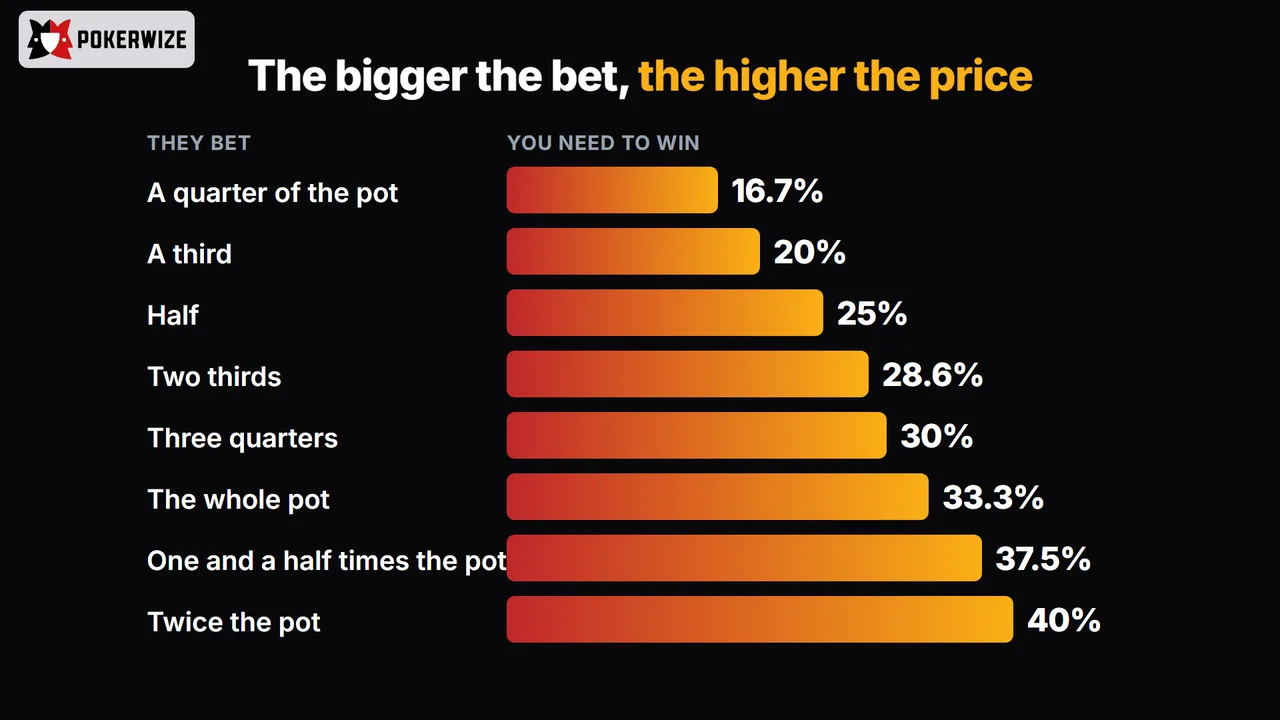
The bigger the bet, the more often your call has to win. These prices hold at any stakes, because they only depend on the bet’s size compared with the pot.
| They bet | You need to win |
|---|---|
| A quarter of the pot | 16.7% |
| A third of the pot | 20% |
| Half the pot | 25% |
| Two thirds of the pot | 28.6% |
| Three quarters of the pot | 30% |
| The whole pot | 33.3% |
| One and a half times the pot | 37.5% |
| Twice the pot | 40% |
Common mistakes
- Leaving your own call out. Calling 20 to win 80 is 20 out of 100, not 20 out of 80. The second sum says 25%, so a call that pays for itself starts to look like a fold.
- Mixing up odds and percentages. Risking 20 to win 80 is “4 to 1”. That means winning 1 time in 5, which is 20%, not 25%.
- Comparing the price with your chance by the river. The Rule of 4 gives your chance over two cards, but you only get both for one price if nobody bets again. When more bets are coming, compare one card at a time.
- Stopping at the price. Pot odds only count the chips in the middle now. What you can win later, and whether your opponent will fold to a raise, can change the answer.
In PokerWize
The PokerWize GTO Trainer shows your EV, your equity and the pot odds live on each decision, so you can check your sum against the real price as you play. The Trainer is in the free plan. For the whole idea on one hand, from the price to the river, watch Episode 3.
Key takeaways
- Pot odds = what you risk ÷ (what you risk + what you can win). Your own call goes into the total.
- Facing a third of the pot you need 20%; facing a pot-sized bet, 33.3%.
- Compare the price with your chance on the next card, not by the river, when more bets are coming.
Related terms
Watch it explained
Learn. Play. Master.
Put it into practice: start training for free at www.pokerwize.com.