How do you work out implied odds?
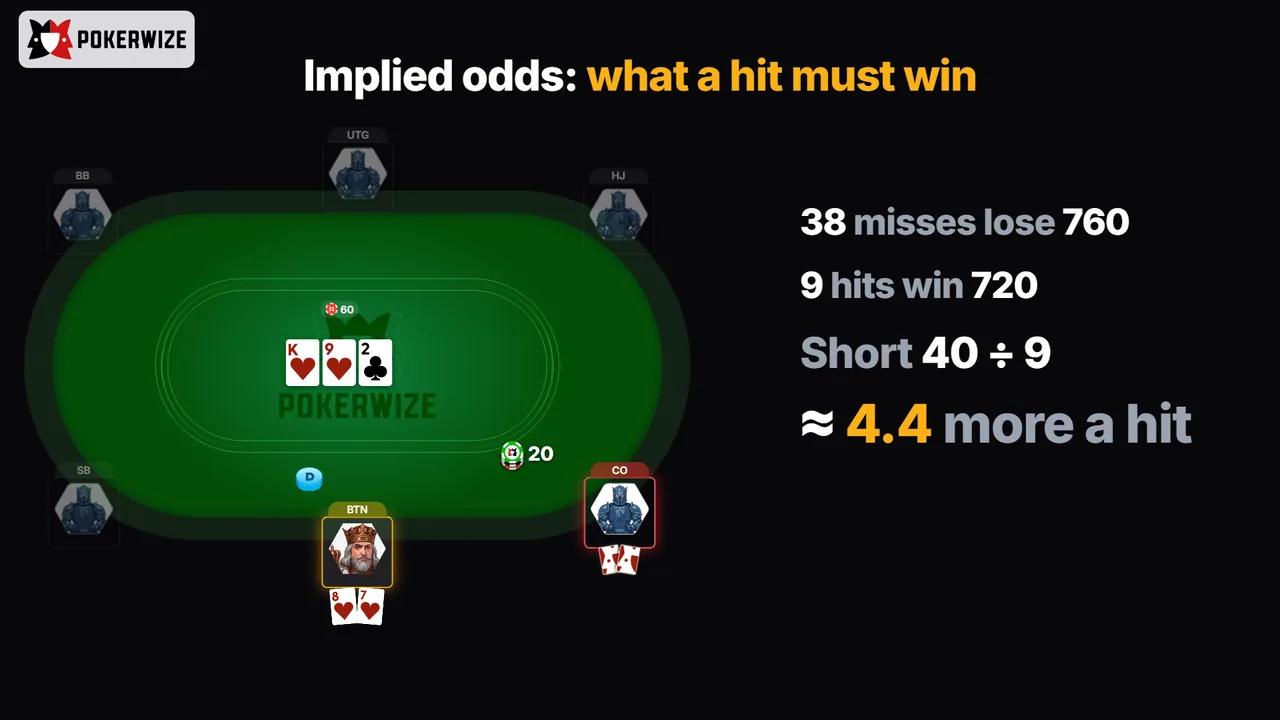
Work out what a call that is short on pot odds has to win later. Facing a bet of a third of the pot with a flush draw, you call 20 to win 80 and hit on the turn 9 times in 47. The 38 misses cost 760 and the 9 hits win 720, so each hit has to win about 4.4 more chips on later streets to break even.
When the price is short
Pot odds only count the chips in the middle now. Implied odds add the chips you expect to win after you hit. They are why players call with draws that look a little too expensive, and why the same call can be right against a deep stack and wrong against a short one.
A worked hand
The cutoff raises and you call on the button with eight-seven of hearts. The blinds fold. The flop comes the king of hearts, the nine of hearts and the two of clubs, and there are 60 chips in the pot. The cutoff bets 20.
You need to win 20% of the time, and the turn brings a heart 9 times in 47, about 19.1%. Picture the call 47 times. You miss 38 times and lose your 20 each time: 760 chips. You hit 9 times and win the 80 in the middle: 720 chips. You are 40 short, so each hit has to win 40 ÷ 9, about 4.4 more chips, on the turn or the river. Win 5 more and the call makes money: an easy ask when you hit a flush.
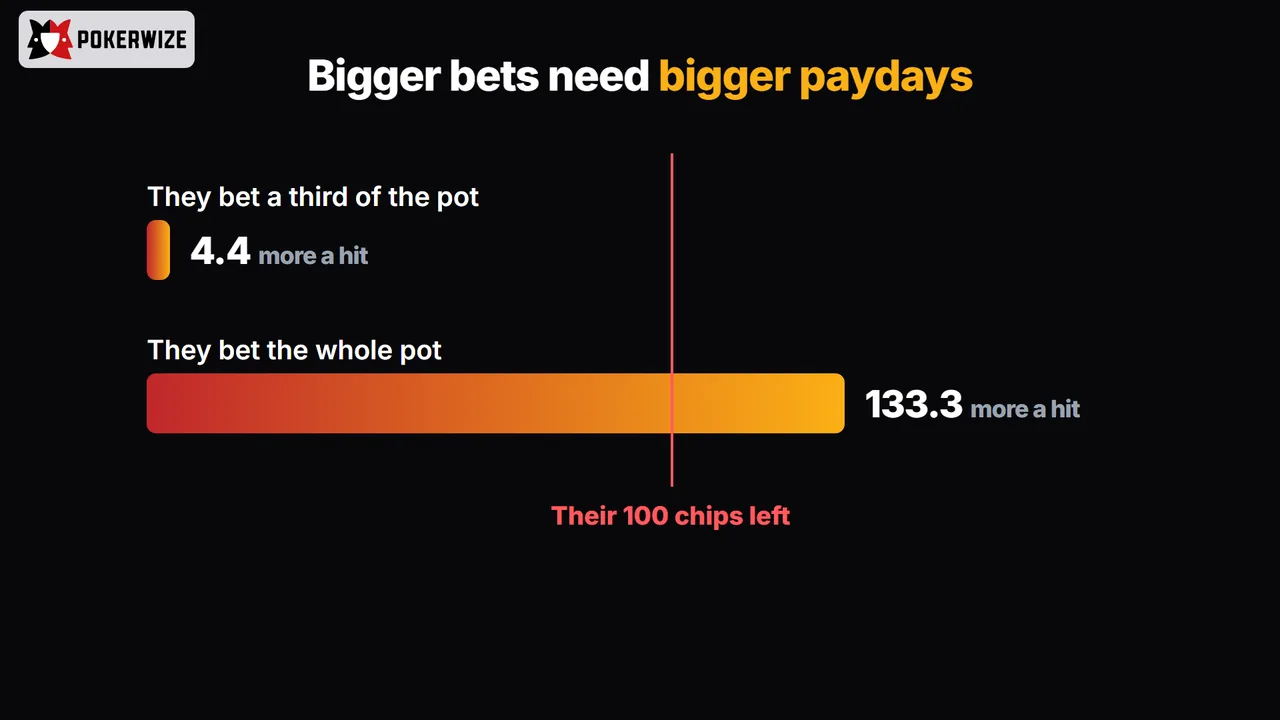
Now say the cutoff bets 60, the whole pot. The misses cost 38 × 60 = 2,280 and the hits win 9 × 120 = 1,080: 1,200 short, about 133.3 more chips a hit. If the cutoff only has 100 chips left after the bet, they can’t pay you that much even if they call everything, and on these sums the call loses however well you play the hit.
These sums count the turn only and treat a miss as the end of the hand. Missing on the turn still leaves you the river, but usually behind another bet.
Common mistakes
- Counting chips their stack doesn’t have. You can’t win more later than they have left. Short stacks mean small implied odds.
- Forgetting that your draw shows. When the third heart lands, everyone can see the flush is possible, and many opponents stop betting.
- Ignoring the hits that still lose. With eight-seven of hearts, a bigger heart flush beats yours. A hit that loses costs you more chips, not fewer.
- Using them to excuse any call. Implied odds are a guess about future chips. The further short of the price you are, the bigger the guess you are relying on.
In PokerWize
The PokerWize GTO Trainer shows the pot odds and your equity live on each decision, so you can see how far short a call is before you make it. The Trainer is in the free plan. For implied odds on a real hand, watch Episode 3.
Key takeaways
- Implied odds = the extra chips you expect to win after you hit, on top of the pot now.
- Facing a third of the pot, a flush draw needs about 4.4 more chips a hit; facing a pot-sized bet, about 133.3.
- Short stacks, an obvious draw and hits that still lose all shrink them.
Related terms
Watch it explained
Learn. Play. Master.
Put it into practice: start training for free at www.pokerwize.com.