What do you do with all of it at the table?
One question at a time. Check the price, the board, the balance and the player, then pick the play with the best expected value. Grade the session by your decisions first and your results last.
Episode 8 of the Pro Mindset series, written out for people who’d rather read than watch. The poker numbers come from GTO solves, computer programs that play poker against themselves until they find an optimal strategy; the rest is simple arithmetic. It follows Episode 7. In the video, each hand stops at “Pause here and decide.” Do the same: decide before you read the answer.
Thank you, and what’s next
Thank you, and congratulations, for making it this far. The PokerWize team is passionate about helping the poker community improve their game. Let us know in the YouTube comments what other kinds of videos you’d like to see. If you missed any of the earlier episodes, they’re all in the Pro Mindset playlist on YouTube. Today we put all of it to work in one short session: three hands, start to finish.
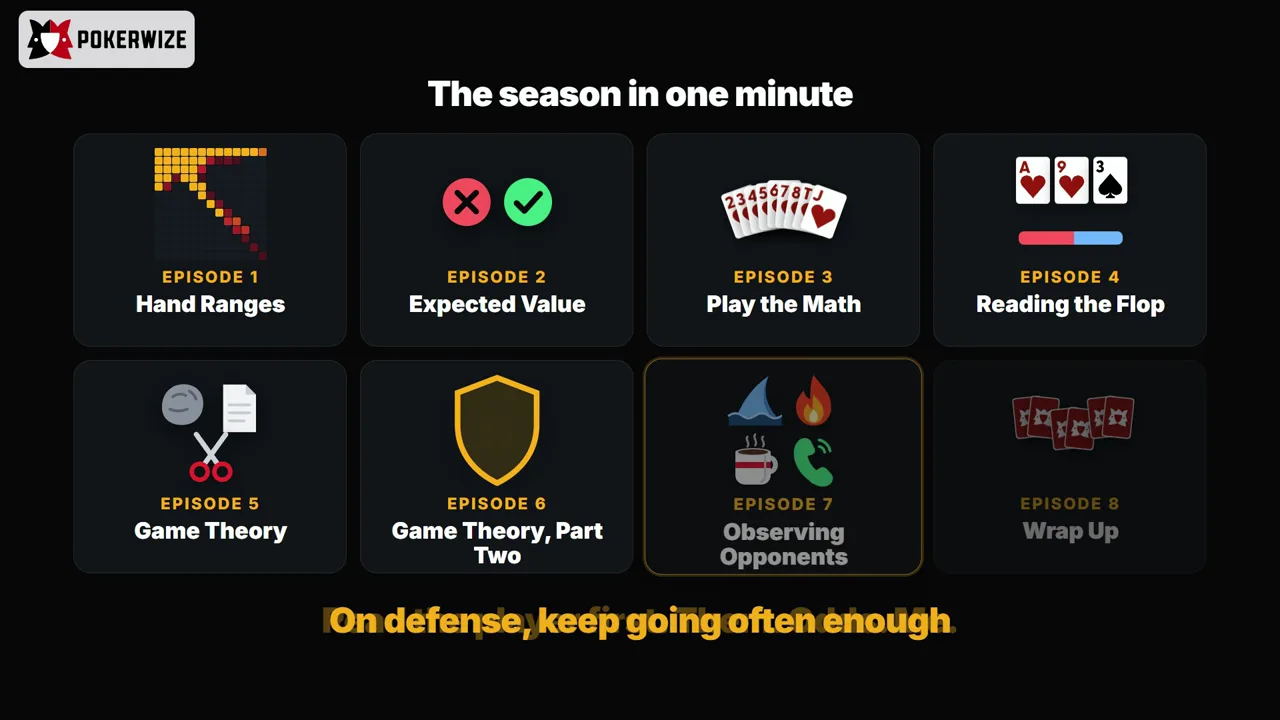
The season in one minute
- Episode 1, Hand Ranges: stop putting a player on one hand. Think in ranges, every hand they could have.
- Episode 2, Expected Value: judge a decision by what it earns on average, not by whether you won the pot.
- Episode 3, Play the Math: pot odds and outs tell you when a draw is worth the price.
- Episode 4, Reading the Flop: every flop helps one range more than the other, and that tells you who should be betting.
- Episode 5, Game Theory: balance your bets and your bluffs, so nobody can exploit you. Like rock, paper, scissors.
- Episode 6, Game Theory, Part Two: on defense, keep going often enough that nobody can bet any two cards against you.
- Episode 7, Observing Opponents: real players aren’t balanced. Read the player first. Them. Odds. Me.
Hand 1: preflop
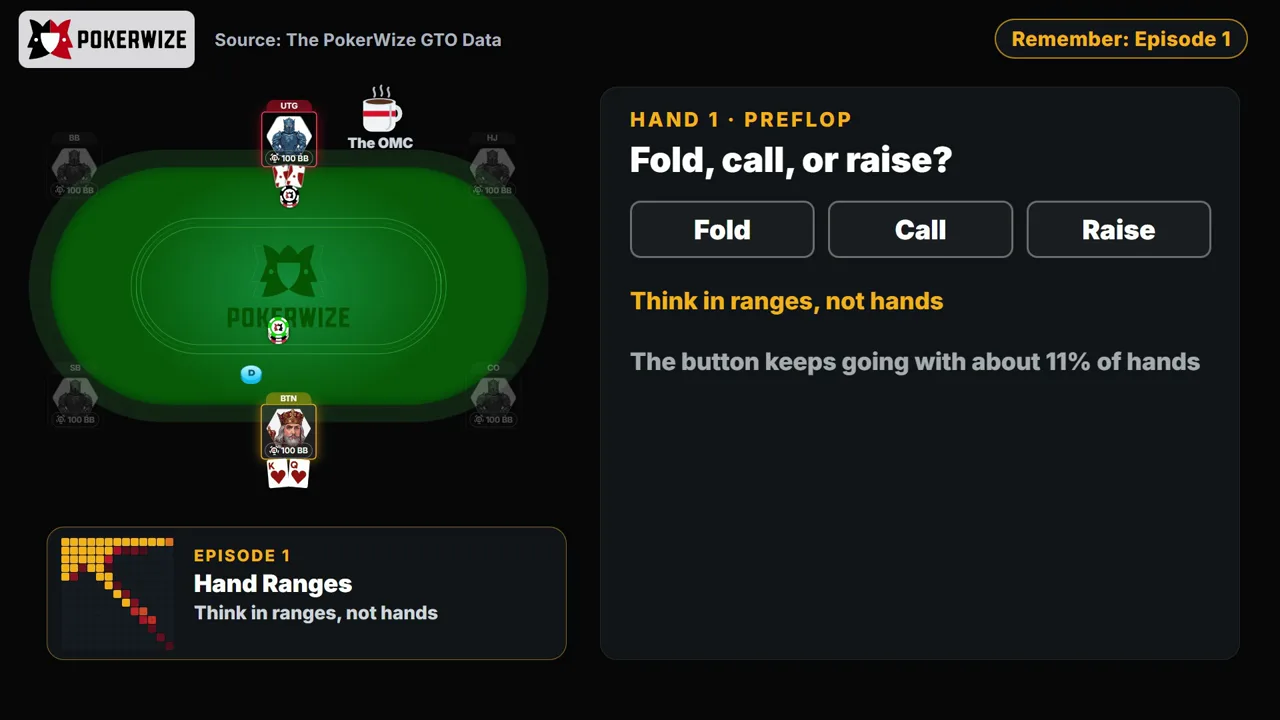
The OMC (old man coffee, who plays few hands and rarely bluffs) opens under the gun, and everyone folds to you on the button with king-queen of hearts. Fold, call or raise? Pause and decide. From Episode 1: think in ranges, not hands. Against an under-the-gun open, the button keeps going with only about 11% of hands, and king-queen suited is one of them. GTO calls it about 6 times in 10 and re-raises the rest. We call.
Hand 1: the flop
The flop is the ace of hearts, the nine of hearts and the three of spades. The OMC bets a third of the pot, and you have a flush draw. Pause and decide. From Episodes 3 and 6: a third of the pot is a price of about 20%, and against that size you have to keep going about 3 times in 4 or they can bet anything. You have 9 outs to the best possible flush. GTO never folds here: it calls about 7 times in 10 and raises the rest, and the call is worth about 6 big blinds. We call.
Hand 1: the turn
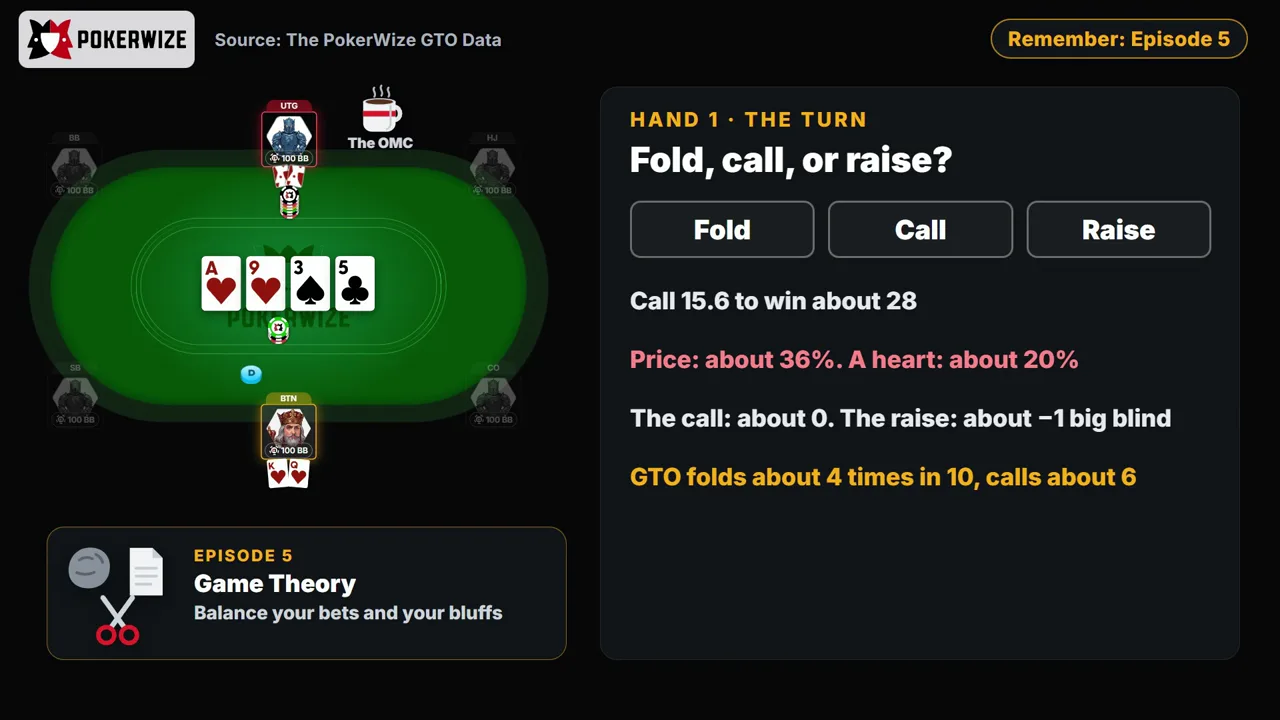
The turn is the five of clubs. No heart. Now the OMC bets one and a quarter times the pot, about 15.6 big blinds. Pause and decide. From Episode 3: you’re calling 15.6 to win about 28, a price of about 36%, and the river brings a heart only about 20% of the time. From Episode 2: against everything they bet here, the call is still worth almost exactly zero and the raise loses about a big blind. From Episode 5: when two plays are worth the same, GTO mixes, folding about 4 times in 10 and calling about 6. So who’s betting? From Episode 7: against a Maniac, lean toward calling; against an OMC, who almost never bluffs that big, lean toward folding. This is the OMC. We fold.
Hand 2: the river
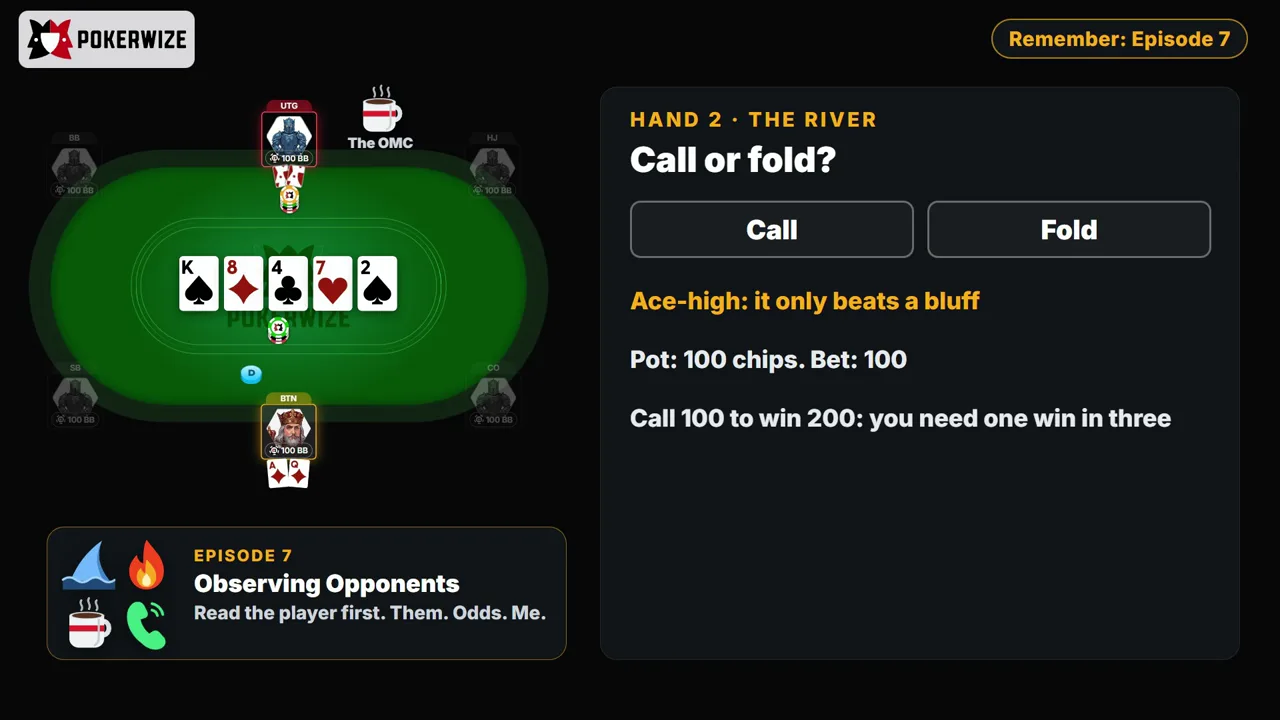
Hand two, the same OMC. You have ace-queen of diamonds and the board runs king, eight, four, seven, deuce. Ace-high only beats a bluff. On the river the pot is 100 chips and they bet 100. Call or fold? Pause and decide. From Episode 5: calling 100 to win 200 needs one win in three. From Episode 7: say the OMC bluffs only one time in ten. Call ten times and you win 200 once and lose 100 nine times, about 70 chips lost every call. We fold.
Hand 3: the bluff
Hand three. You have six-five of spades on a flop of queen, jack, deuce. You missed everything, and the Calling Station checks to you. Bluff 2.5 big blinds into 7.5, or check? Pause and decide. From Episode 6: that bluff needs folds about a quarter of the time. The Calling Station never folds, so every bluff just loses the 2.5 you bet. We check, and save the big bets for when we have a hand.
Grade the session
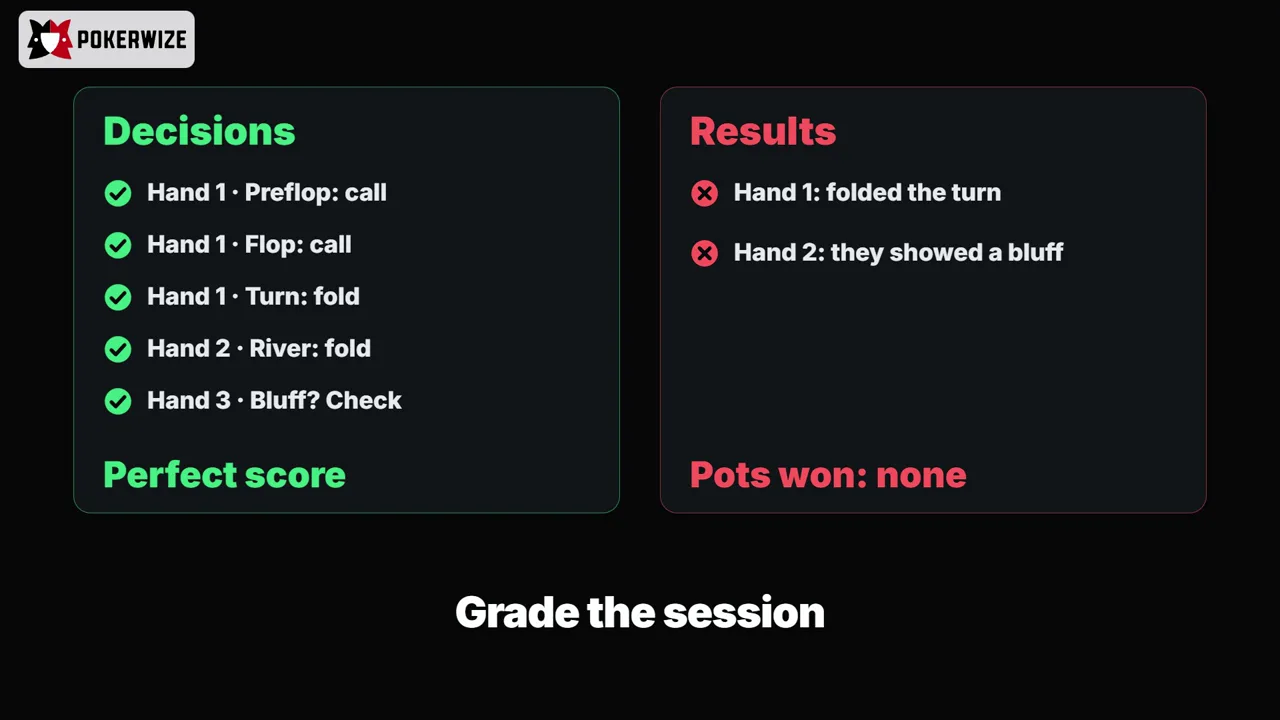
Now grade the session the way Episode 2 taught: decisions first. Every choice followed the price, the board, the balance and the player. That’s a perfect score. Results last: three hands, and not one pot won. On the river the OMC even showed a bluff. That’s poker. Results are what happened tonight. Decisions are what you control, and over thousands of hands your decisions become your results.
Season complete
That’s the season. You now think about every decision the way a pro does. If you want to keep practicing, the PokerWize GTO Trainer shows the EV, your equity and the pot odds of each decision live. Decisions first, results last.
Key takeaways
- Check the price, the board, the balance and the player, then take the best-EV play.
- The session: call, call, fold, fold, check. A perfect score on decisions, and not one pot won.
- Results are what happened tonight. Decisions are what you control.
Learn. Play. Master.
Put it into practice: start training for free at www.pokerwize.com.