Why does GTO check ace-king half the time?
Because a strategy that bets every strong hand and checks every weak one is easy to read. GTO (game theory optimal) mixes, so a bet never means “I have it” and a check never means “I missed.” It only mixes between plays that are worth the same, so mixing costs nothing.
Episode 5 of the Pro Mindset series, written out for people who’d rather read than watch. The poker numbers come from GTO solves, computer programs that play poker against themselves until they find an optimal strategy. It follows Episode 4.
Remember Episode 4
In Episode 4 we read the flop with both ranges. On our flop, under the gun had a small range advantage, so GTO bet small and only about a quarter of the time. But one number didn’t sit right: ace-king, top pair with the best kicker, bets only about half the time. Why would anyone check a hand that good?
Amateur vs pro
“They bet big, so they must have it.” “I bet when I have it and check when I don’t.” That’s the amateur talking: each hand played on its own. The pro asks a bigger question: if they could see how I play every hand here, could they beat me? A good strategy holds up even when the other player knows it.
The hand, and the puzzle
Our hand again. Under the gun raises, the hijack and the cutoff fold, and you call on the button with king-queen of hearts. The flop comes the ace of hearts, the nine of hearts and the three of spades, and under the gun bets a third of the pot. If you were under the gun you’d probably bet ace-king here every single time. So why does GTO check it half the time? The answer starts with a game you already know.
Rock, paper, scissors
Say your friend throws rock every time. A few rounds and you notice, throw paper every time, and win every game. That’s an exploit: you spot a pattern and change your play to beat it. So what’s the fix? Throw each one a third of the time, at random. If your friend throws rock every time, a third of the time you throw paper and win, a third you throw scissors and lose, and a third it’s rock against rock, a tie. One win, one loss, one tie: zero. Paper every time or scissors every time gives the same zero. Nothing they do can beat you.
That’s a balanced strategy, and it’s what game theory is about. GTO stands for game theory optimal: a strategy so balanced that nobody can beat it by adjusting to it, even if they know exactly what it is. In rock, paper, scissors the best that gets you is a tie. In poker, players make mistakes, and when they stray from the balance, GTO profits from most of them.
Betting your strong hands every time and checking the rest is throwing rock every time. The button would learn it fast: a bet means a big ace, a check means a miss, so attack every check. GTO doesn’t give them that. When under the gun bets, about 3 in 10 of those hands don’t even have a pair. When they check, more than a third of those hands still have a pair of aces or better, and even three of a kind checks about 6 times in 10. A bet doesn’t say “I have it,” and a check doesn’t say “I missed.” That’s why ace-king checks half the time.
Value bets and bluffs
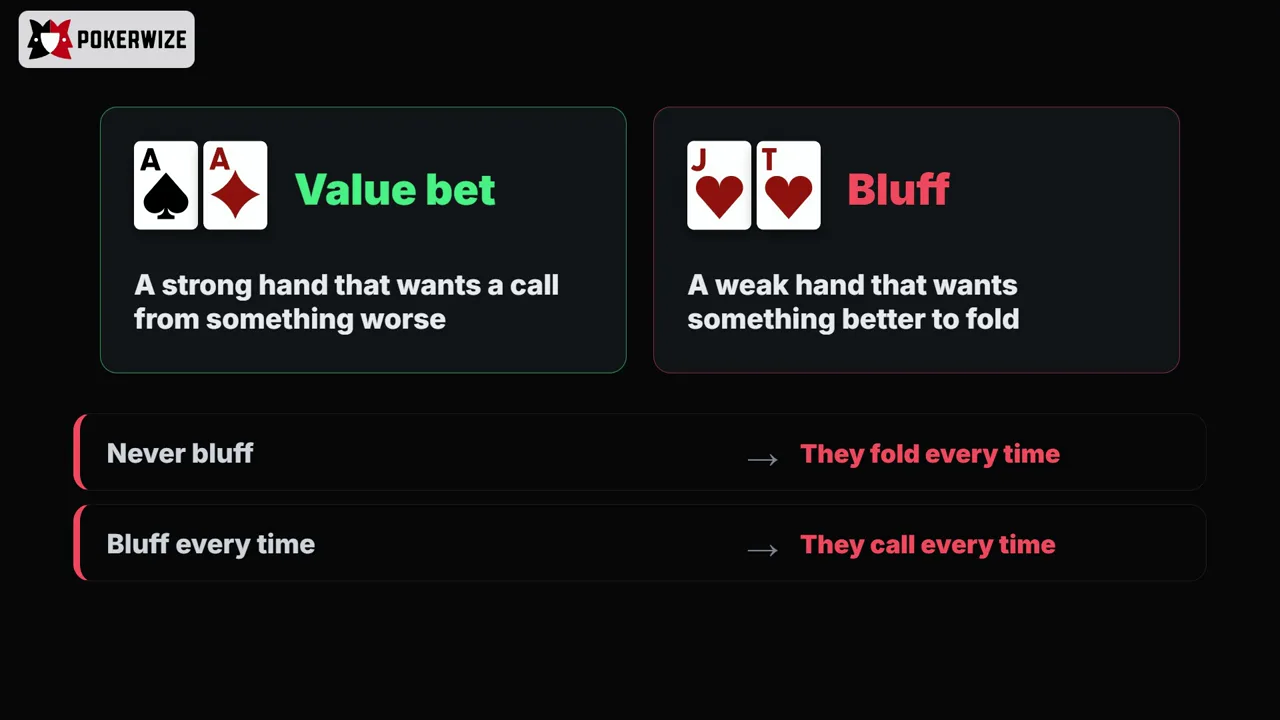
Every time under the gun bets, it’s betting two kinds of hands. A value bet is a strong hand that wants a call from something worse. A bluff is a weak hand that wants something better to fold. Never bluff, and a good player folds every time you bet. Bluff every time, and they call every time.
Three hands, three calls
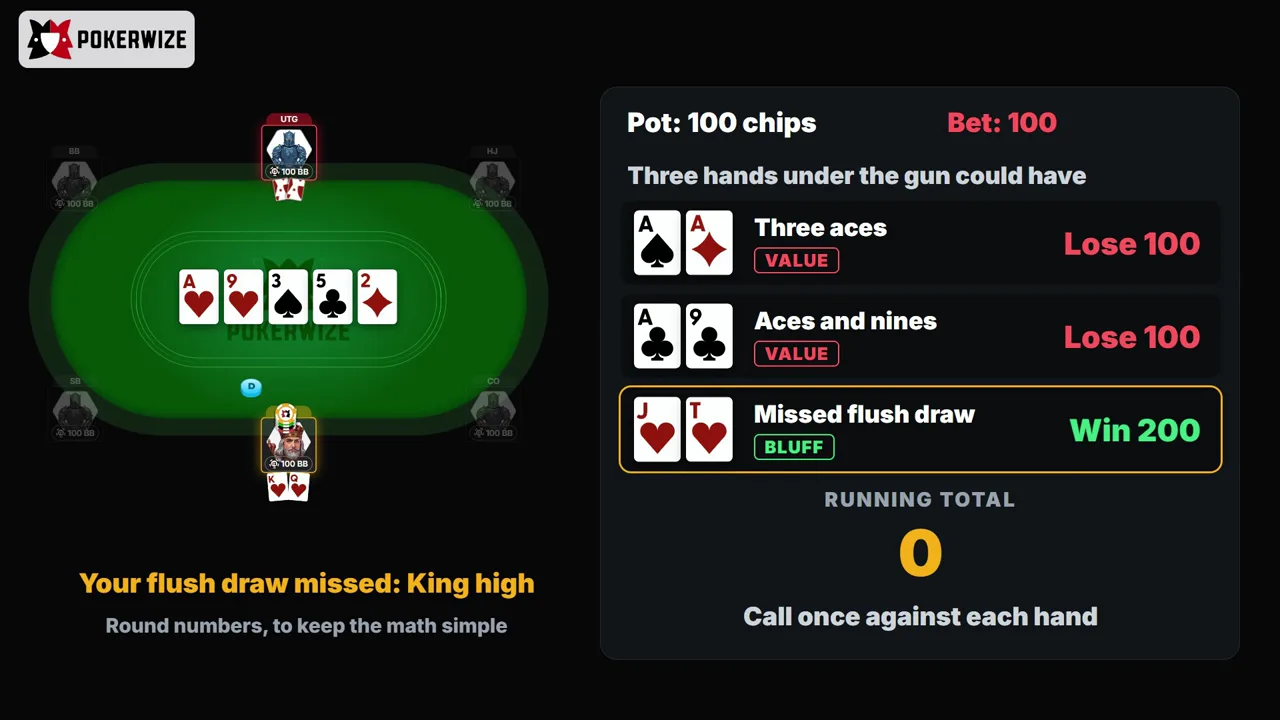
How many bluffs is the right number? Work it out on our hand. Say you call the turn and the river is the two of diamonds. Your flush draw missed, so you have king high. To keep the math simple, the pot is 100 chips and under the gun bets 100. Give under the gun just three hands: three aces, two pair (aces and nines), or the jack and ten of hearts, a flush draw that missed. That’s two value hands and one bluff, and your king high beats only the bluff. Call once against each. Against three aces you lose 100. Against two pair you lose another 100. Against the bluff you win the 200 in the middle. Lose 100, lose 100, win 200: zero. And if you fold, you win nothing and lose nothing. That’s zero too. Calling and folding are worth exactly the same.
Why one bluff in three
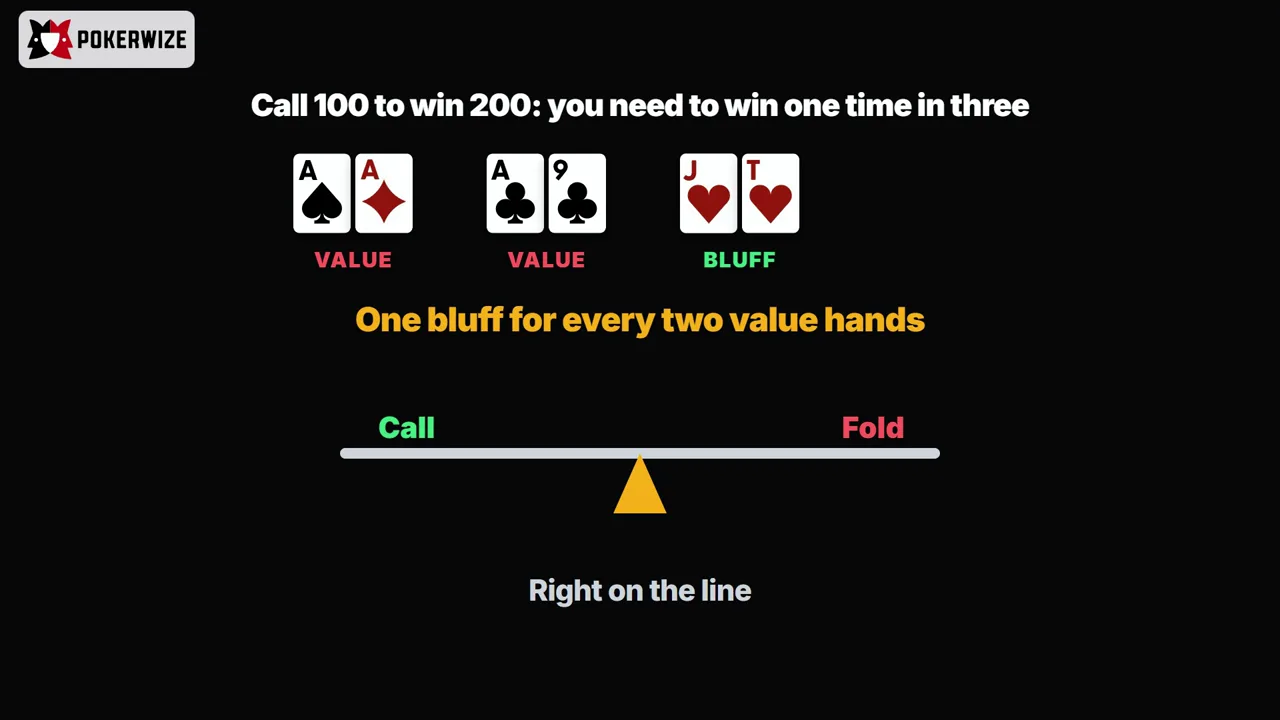
That mix isn’t a guess. From Episode 3: when you call 100 to win 200, you need to win one time in three. One bluff for every two value hands puts you right on that line. Add more bluffs and calling wins. Take bluffs away and folding wins.
Back to the turn
Remember Episode 2: on the turn, under the gun bet big, and GTO said calling with king-queen of hearts was worth almost exactly zero. It’s the same math you just watched. Under the gun’s big bet has just the right mix of value hands and bluffs, so calling and folding are worth the same. And when two plays are worth the same, GTO does both: king-queen of hearts folds about 4 times in 10 and calls about 6 times in 10. That isn’t GTO being unsure. It’s GTO being balanced.
The rule behind every mix
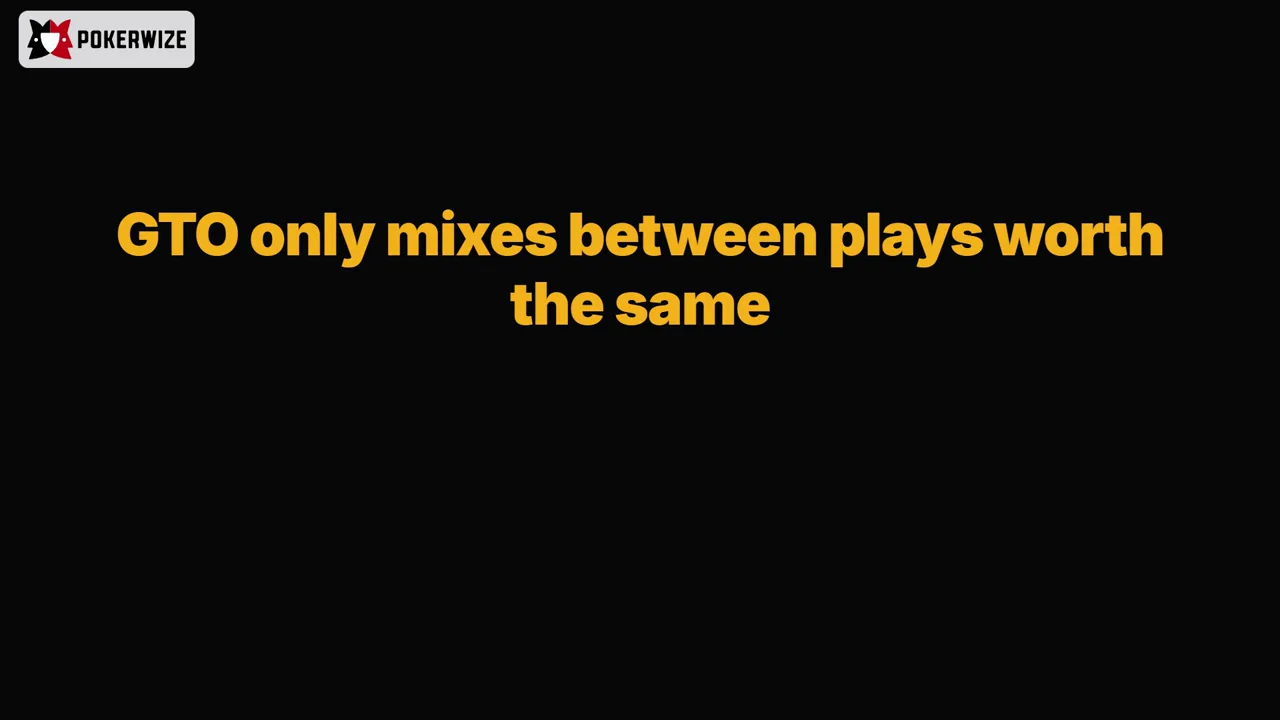
That’s the rule behind every mix you’ll see from GTO: it only mixes between plays that are worth the same. If one play were worth more, it would make that play every time.
Balance is your shield
Should you always play like this? Think of balance as your shield. Against a strong player it keeps you from getting beaten. But most players aren’t balanced. Some almost never bluff and some call everything. Spotting them and beating them comes later in the series.
Every hand you could have
Next time you bet, don’t just ask what your hand wants to do. Ask what you’d do with every hand you could have here. Would a bet here ever be a bluff? Would a check ever be strong? If the answer is no, a good player can read you like a book. You’re not trying to hide your cards. You’re trying to make your whole strategy impossible to beat. You can practice spots like this in the PokerWize GTO Trainer, which shows the EV, equity and pot odds of each decision live.
Key takeaways
- GTO is a strategy so balanced that nobody can beat it by adjusting to it, even if they know it.
- A bet is value or a bluff. Against 100 into 100, one bluff for every two value hands makes calling and folding worth the same (zero).
- GTO only mixes between plays worth the same: ace-king checks about half the time, king-queen of hearts folds about 4 in 10 and calls about 6 in 10.
- Ask what you’d do with every hand you could have here, not just the one you hold.
Learn. Play. Master.
Put it into practice: start training for free at www.pokerwize.com.